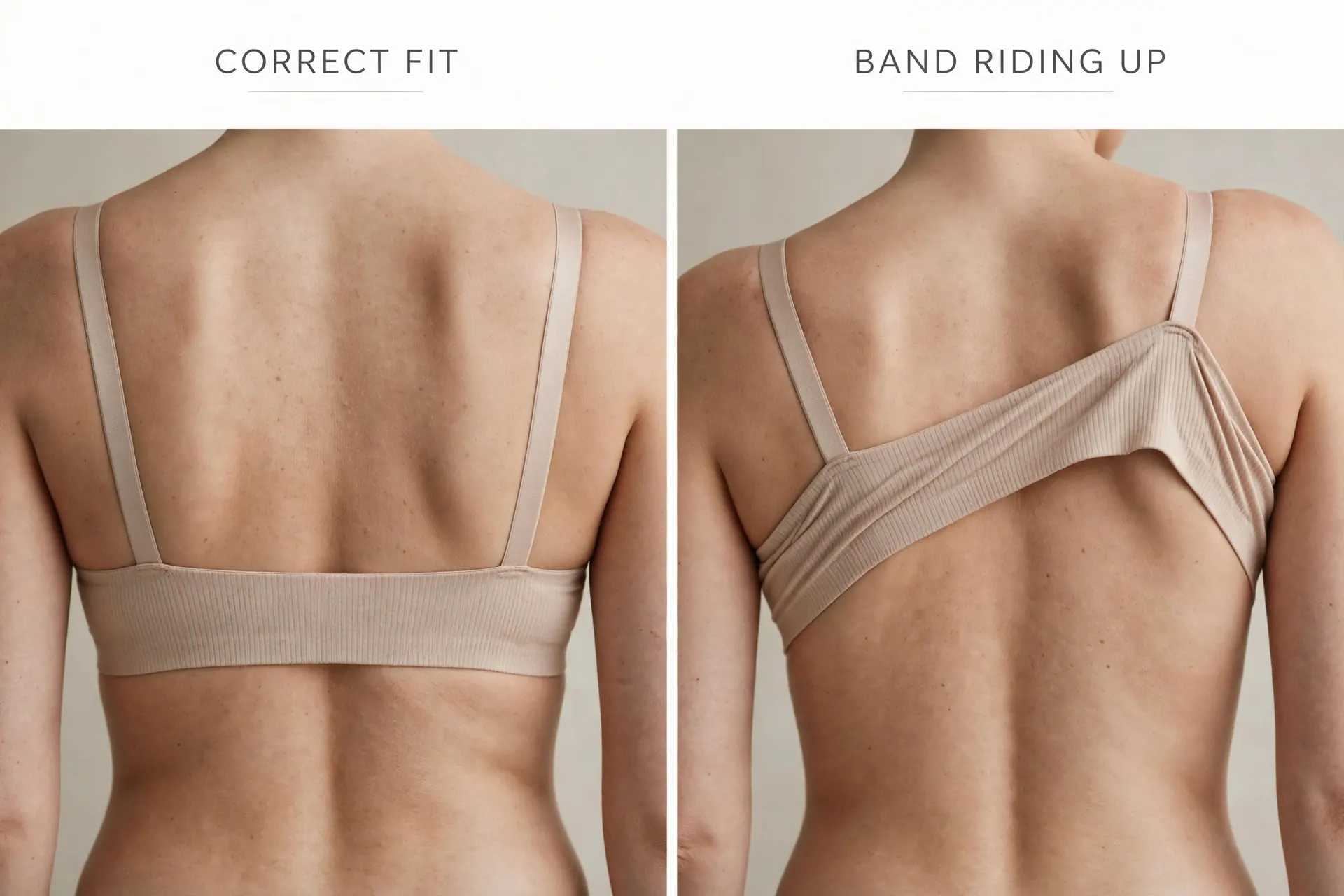
If you’re tugging your bra band back down by lunchtime — or it creeps toward your shoulder blades every time you raise your arms — you’re dealing with one of the most common bra fit problems there is. Triumph cites a Chiropractic & Osteopathy study finding that as many as 80% of women wear the wrong bra size, and a riding-up band is one of the clearest symptoms.
Here is the short version: a band that rides up your back is almost always too big — too loose around your ribcage to hold its position. It is not, as some guides claim, a sign the band is too tight. That distinction matters, because the fix for “too loose” is the exact opposite of the fix for “too tight” — and following the wrong advice makes the problem worse.
This guide explains why it happens, how to check your own fit in about a minute, and how to fix it — from free adjustments to knowing when a bra is simply done.
The short answer: your band is too loose, not too tight
Say it plainly: if your bra band rides up your back, the band is too big for your ribcage. Triumph’s fit guide puts it directly: a band riding up at the back means the bra is too big around your body, and you need a smaller band size.
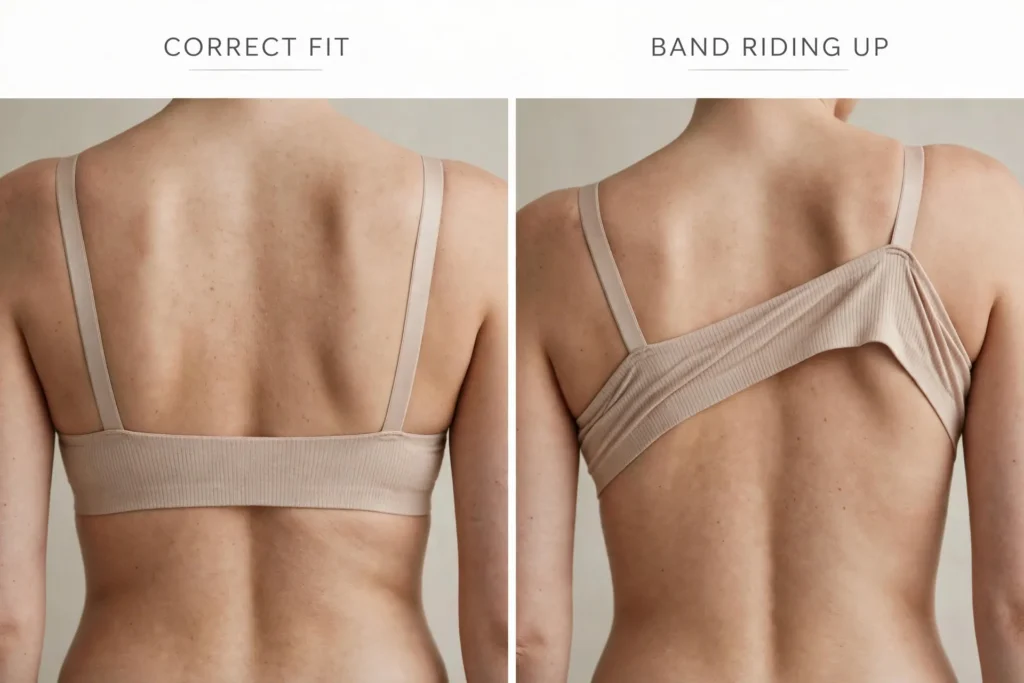
This surprises people, because a riding band feels uncomfortable — and discomfort reads as “too tight.” But a genuinely too-tight band behaves differently: it digs in, leaves lasting marks, and restricts breathing. A band that travels upward has the opposite problem. It cannot grip your ribcage, so it migrates to where your torso is narrower and it can hold on a little.
Getting this backwards is the costliest mistake you can make here, because some published guides do get it backwards. At least one retailer’s fit guide states that “if the bra is too tight, the band will keep riding up” and advises sizing up. Follow that advice with a band that is already too loose, and you will buy an even looser band — and the ride-up gets worse.
Why a loose band climbs: the simple mechanics
A bra supports you through its band — the part that wraps your ribcage — not through its straps. As fit specialist Robynne Winchester explains in Healthline’s bra fit guide: “The majority of a bra’s support comes from the band, not the straps or cups.”
A band works by gripping. When it is snug, it anchors the whole bra in place and carries the weight around your body. When it is loose, two things happen at once. First, the band cannot anchor, so the weight of your bust drags it upward toward the narrower part of your torso, where it can grip slightly better. Second, your body compensates: with the band doing little work, the straps take the load — and tight straps pull the back of the band up toward your shoulders.
Winchester describes it as a see-saw: “Tightening the straps when the band is loose causes the band to ride up in the back, which further compromises support. Think of a see-saw — when the back goes up, the front goes down.”
That is why the instinct to tighten the straps when the band rides up backfires: you are hauling the back of the band upward even harder.
The 5 causes of a riding-up band
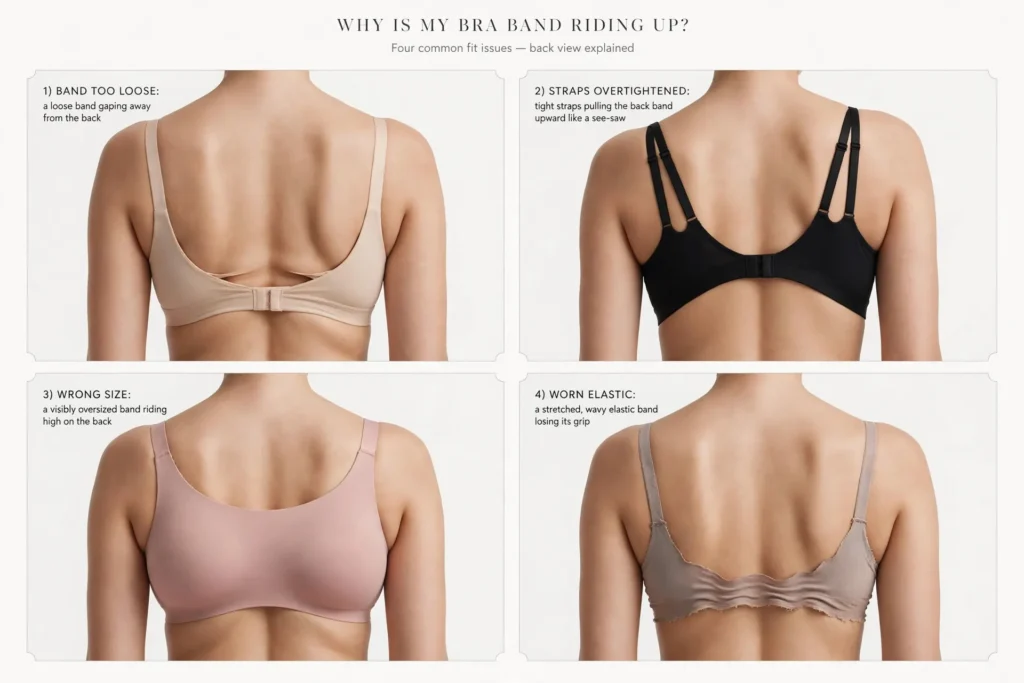
1. The band is simply too big
This is the headline reason, and the most common bra fit error there is. Part of the blame goes to an old measuring habit: some guides still tell you to add four or five inches to your underbust measurement before choosing a band. Modern fitters have moved away from that method precisely because it lands most women a size or two too big before they have even tried anything on. If your “measured” size came from a plus-four method, your band may have been too big from day one.
The fix: go down one band size — and up one cup letter at the same time so you do not lose cup room (more on this in the fixes section).
2. Your straps are too tight
This is the sneaky one, because over-tightening the straps is what most people do to try to fix the problem. Remember the see-saw: tight straps pull the back of the band upward. So tightening the straps to stop the ride-up makes the ride-up worse.
Quick check: you should be able to slide one finger under each strap without forcing it. The fix: loosen the straps first, then reassess the band. Many women find that much of the ride-up disappears right there.
3. The elastic is worn out
Band elastic tires with wear and washing. Every wear stretches it, and heat and agitation wear it down, until eventually it cannot recover its shape between wears.
Quick test: if the band only feels supportive on the tightest hook and still climbs, the elastic is done. That is a replace, not a repair. Rotating between several bras — so each one gets a rest day between wears — and washing gently (a mesh bag, never the tumble dryer) makes every bra last noticeably longer.
4. The cups are too small
When the cups cannot contain your breast tissue, the tissue pushes the bra up and away — the front creeps upward and the whole bra shifts. Winchester notes that the most common fit issue she sees is “a cup that’s too small and a band that’s too loose” occurring together. If you see spillage over the top or sides along with the ride-up, suspect the cups as well as the band.
The fix: go up a cup size — using a sister size so the band stays snug while the cup grows.
5. Your body changed, but the bra didn’t
Weight changes, pregnancy, nursing, menopause, aging, even medication — all of these move your underbust measurement. A band that gripped perfectly last year can be loose now. That is not a flaw; it is an ordinary body doing ordinary things while the bra stays the size it always was.
The fix: re-measure whenever your body changes, rather than assuming your size is fixed for life.
How to check your band: 5 tests at the mirror
Put the bra on and do the “scoop and settle” first: lean forward, reach into each cup, and settle all your breast tissue forward and up into the cups, then stand up straight. (Fitters call this the “scoop and swoop,” and Winchester recommends it as part of checking any fit — a half-filled cup lets the bra travel.) Then run these five tests. No tape measure needed.
- The level test. Stand side-on to a mirror and look at the line of the band. It should read as one straight, horizontal line all the way around — level with the bottom of the cups at the front. If it angles up toward your shoulder blades, the band is too big.
- The pull test. Pull the back band straight out from your body. If it stretches more than about two inches — roughly two fingers’ width — the band is too big, and no adjustment will fix that.
- The two-finger test. Slide two fingers under the band. They should go in snugly, with a little tension. If your whole hand fits underneath, the band is too loose.
- The arms-up test. Raise both arms straight overhead, then lower them. A well-fitting band barely shifts. A loose band jumps up and stays there — the whole problem in a single movement.
- The hook test. Check which hook you are fastened on. A new bra should fasten comfortably on the loosest hook — the tighter hooks are your reserve for later, as the elastic relaxes with months of wear. If a bra only feels supportive on the tightest hook from day one, it is already the wrong size for you.
How to fix it, in order: free fixes first
Work down this list. The early steps cost nothing and take a minute; the later ones cost money, so rule out the cheap fixes first.
1. Loosen and reset the straps. Slide them right out, put the bra on, and tighten only until you can still slip a finger underneath. A surprising share of ride-up disappears right here.
2. Scoop and settle (described above). A bra that is only half filled at the front will travel.
3. Move to a tighter hook. If your bra has lived on the loosest hook for months and stretched, the middle or tightest hook may restore the grip for a while.
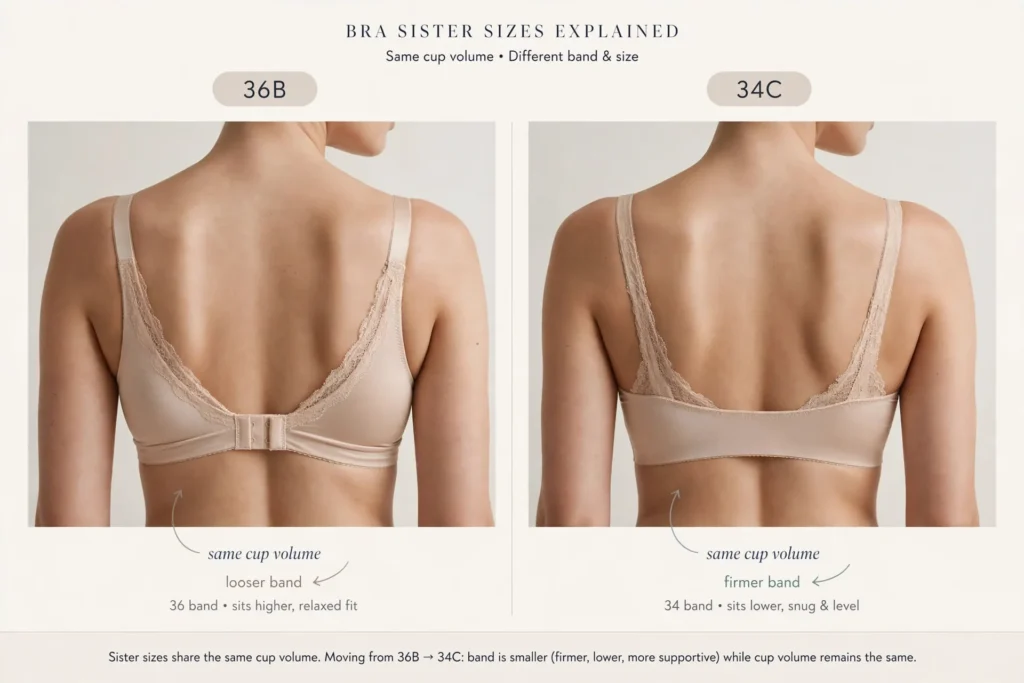
4. Sister-size down: one band size down, one cup size up. This is the core fix when the band is too big but the cups fit. Going down a band size tightens the grip; going up a cup letter keeps the same cup volume so you do not lose room. Example: if you wear a 36B, try a 34C — same cup volume, firmer band. This is the standard sister-size relationship: down a band and up a cup (or the reverse), confirmed by multiple fit references, including bra-calculator.com’s fit table, which prescribes exactly this for the symptom “band rides up but cups look right.” Treat sister sizes as a starting point — actual cup and band fit vary between brands and styles.
5. Know when the bra is done. On the tightest hook and still climbing? The elastic is finished. Nothing revives dead elastic — replace the bra.
6. For your next bra, shop for grip. A wider back band and more hook columns distribute pressure across your ribs and resist migration — especially helpful for a fuller bust. (This is about which features to look for, not which products to buy.)
One thing deliberately not on the list: a band extender. Extenders add length — which is exactly what a riding-up band already has too much of. They are for bands that are slightly too tight, not for this.
Bad advice to ignore
A few pieces of advice on this topic are actively backwards. If you have read any of these, here is why to disregard them:
- “Riding up means it’s too tight — size up.” Backwards. A riding band cannot grip; sizing up a loose band makes it looser and the ride-up worse.
- “Tighten your straps to pull the band down.” Backwards. Tight straps pull the back of the band up — the see-saw effect described above.
- “Start new bras on the tightest hook.” Backwards. New bras belong on the loosest hook, with the tighter hooks kept in reserve for when the elastic ages. Starting on the tightest hook leaves you nowhere to go within a few months.
- “Use a band extender to stop ride-up.” Extenders lengthen the band. That is the wrong direction for a band that is already too long.
Frequently asked questions
Does a riding band mean my bra is too tight?
No — almost always the opposite. A too-tight band digs in, leaves lasting marks, and restricts breathing. A band that climbs your back cannot grip your ribcage. If the band rides up, think “too big,” not “too tight.”
Will tightening my straps stop the band riding up?
No — it usually makes it worse. Straps steady the cups; the band does the anchoring. Over-tight straps haul the back of the band upward toward your shoulders.
Can I fix it without buying a new bra?
Sometimes. Reset the straps, scoop and settle, and move to a tighter hook — if the bra still has hook reserve and the elastic is alive, that can be enough. If you are already on the tightest hook and it still climbs, the bra is done and no adjustment will save it.
How do I know whether it’s the band or the cups?
Watch which end travels. Back climbs while the front stays level: the band is too big. Front creeps up with spillage over the cup edge: the cups are too small. Both ends climb together: loosen the over-tightened straps first, then check the band.
My band only rides up when I raise my arms — is that normal?
A slight shift that settles back down when you lower your arms is fine. If the band jumps up and stays up, that is the arms-up test failing — the band is too loose to anchor.
A final note
This guide is research-based fit guidance, not professional fitting advice. Bodies differ — ribcage shape, tissue softness, and posture all affect how a bra fits — and no article replaces trying bras on. If you have worked through the checks and fixes here and nothing sits right, an in-person professional fitting is worth it.
Sources
- Healthline — “Tight Bra: Signs of Tight Bra, Ways to Fix Tight Bras, and More” — https://www.healthline.com/health/tight-bra
- Triumph — “How to know if your bra is not pulling its weight” — https://vn.triumph.com/en/blogs/community/nh%E1%BA%ADn-bi%E1%BA%BFt-ao-ng%E1%BB%B1c-khong-ph%E1%BB%A3p
- Fine Lines Lingerie — “Why does my bra ride up at the back?” — https://finelineslingerie.com.au/blogs/news/why-does-my-bra-ride-up-at-the-back
- Novella Fit — “Bra Band Riding Up? 9 Proven Fixes to Stop It Fast” — https://novellafit.com/blog/bra-fit-problems/bra-band-riding-up/
- bra-calculator.com — fit-check table — https://bra-calculator.com/bra-cup-size-from-photo/