A strapless bra makes a bold promise: full support, no straps. When it works, you forget it’s strapless — you dance, you reach for things, you live your evening. When it doesn’t, you spend the whole time doing the subtle tug-up, the bathroom readjustment, the quiet panic that it’s migrating south in public.
Here is the uncomfortable truth most guides skip: a strapless bra that falls down is not a mystery, and it’s rarely “just how strapless bras are.” It is a mechanical failure with a specific cause — and once you identify which cause is yours, the fix is usually straightforward.
The key insight is structural. A regular bra has two support systems: the band and the straps. Remove the straps, and the band must do one hundred percent of the anchoring alone. Every strapless failure — every slip, slide, and slow descent — is a band failure: the band can’t grip, the band can’t hold its shape, or something is defeating the band’s grip. Diagnose the band, and you diagnose the bra.
This guide follows the same diagnostic method as our other fit guides: Problem → Cause → Signs → Quick test → Fix. Work through the 60-second check first — most readers will find their cause there without reading the whole article.
How a Strapless Bra Actually Stays Up
Forget the tips lists for a moment. A strapless bra is a small machine with three cooperating parts:
1. The anchor: the band. The band wraps your ribcage and grips it through elastic tension plus friction against your skin. Gravity pulls your bust downward constantly; the band resists by holding its position around your torso. This is the entire support system. There is no backup.
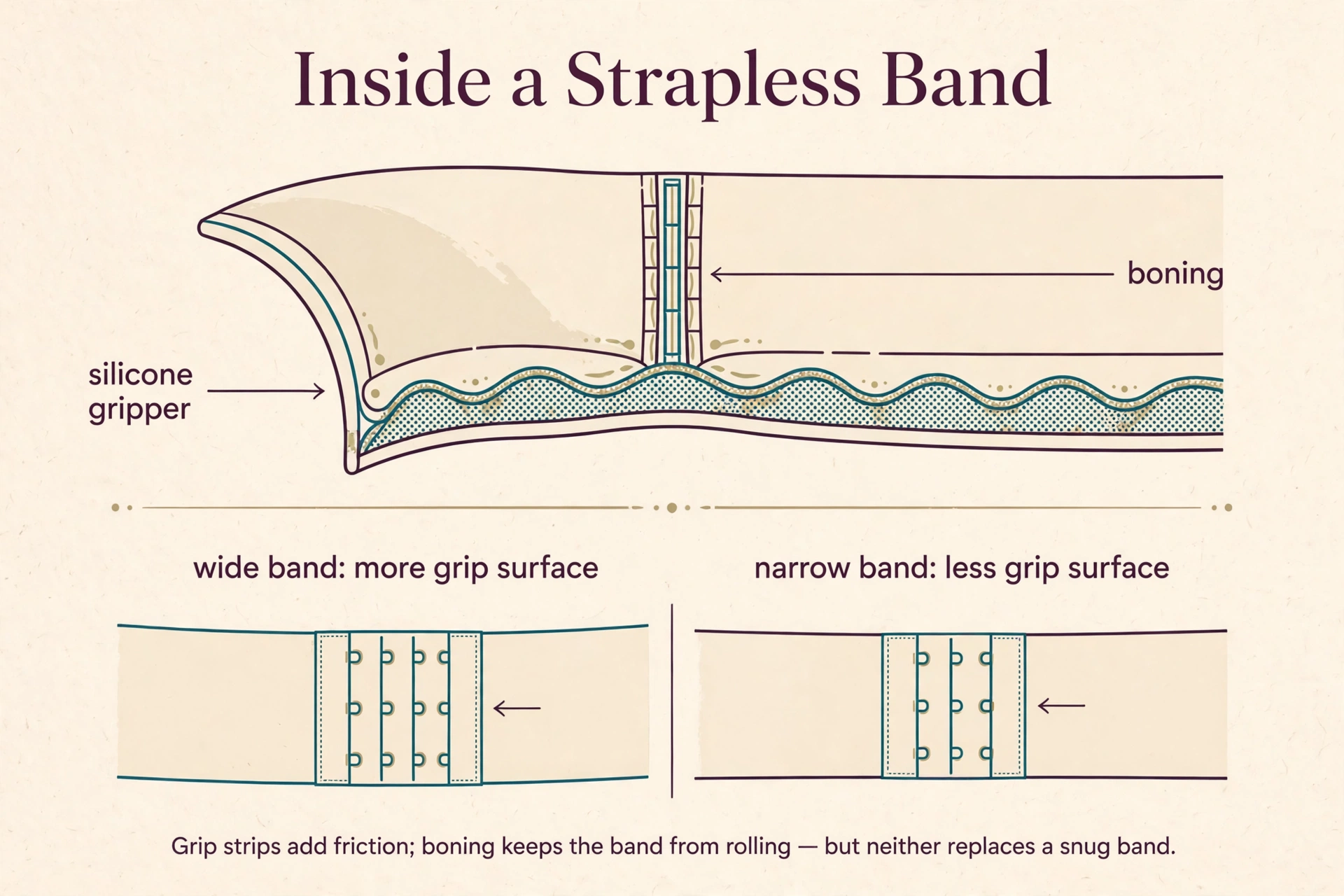
2. The friction helpers: silicone gripper strips. Most strapless bras have thin silicone or rubberized strips along the inside top and bottom edges of the band. These increase friction between the bra and your skin — but they are helpers, not the engine. As bra construction writers at Tutti Rouge explain, silicone is “an extra helping hand rather than the main support system”: a correctly fitted strapless bra should stay in place because of its construction, with the silicone adding extra security. If the band doesn’t grip on its own, no amount of silicone saves it.
3. The structure: boning, underwire, and band depth. Flexible boning sewn into the sides of the band keeps it from rolling or folding as you move — a rolled band has a fraction of the grip surface. Underwires lift and shape each breast so the weight sits where the band can manage it. A deeper or wider band gives the whole system more contact area to work with.
Why strapless fit rules are stricter than regular bra rules: with no strap load path, the band must grip harder from the start. Fitters generally advise that a strapless band should feel firmer than your everyday bra band — snug and secure on first wear, not “comfortable and relaxed.” That firmness is not a flaw; it’s the design working. (How firm is too firm is covered under Cause 1 — there is a line, and crossing it creates its own problems.)
The 60-Second Diagnostic
Do these in order. Stop at the first one that fails — that’s probably your cause.
1. The two-finger test. Slide two fingers under the band at your back. If you can fit more than two fingers comfortably, the band is too loose — go to Cause 1. If you can barely fit one and the band digs, the band may be too small — read the myth-correction section before sizing down blindly.
2. The arms test. Raise both arms overhead, then lower them. Does the band stay level, or does it slide down / ride up at the back? Movement here means the anchor is failing — Causes 1, 2, or 3.
3. The bend test. Bend forward at the waist. Do the cups gape open badly, or does breast tissue spill over the top or sides? Gaping or spillage points to Cause 4 (cup size or shape).
4. The tug test. Gently pull the front of the bra down about an inch and let go. Does it spring back into place, or does it stay where you dragged it? No spring-back means the elastic is dead — Cause 2.
5. The grip check. Run a fingertip along the inside top edge of the band. Can you feel the silicone strip — slightly tacky, slightly raised? If the inside feels smooth like plain fabric, the grip is missing or worn away — Cause 3.
6. The skin check. Did you put on body lotion this morning? Are you warm or perspiring? Fresh lotion and sweat both kill friction — Cause 6.
If everything above passes and the bra still falls, the remaining suspects are construction (Cause 5) or your outfit (Cause 7) — read on.
Cause 1: The Band Is Too Loose
This is the single most common reason, and the one every fitter names first. A band that is too large for your ribcage cannot generate the tension it needs to grip — and without straps to compensate, a loose band simply travels downward under the weight it’s supposed to carry.
Signs
- The bra slides down gradually through the day, worse when you move
- You can fit three or four fingers under the band easily
- The back of the band creeps upward while the front drops (the classic see-saw: a loose band migrates toward where your torso is narrower)
- You bought your “usual” bra size in a strapless style and assumed it would behave the same
The check
The two-finger test from the diagnostic above. Also check which hook you’re on: if you’re already on the tightest hooks and it’s still loose, the band size is wrong — not the hook setting.
The fix
Go down one band size — and up one cup letter at the same time so you do not lose cup room. A 36C becomes a 32D: same cup volume, firmer band. This is called sister sizing, and it’s the correct form of “size down.” Our guide to why bra bands ride up explains the band-as-anchor mechanics in depth — the same physics applies here, with higher stakes because there’s no strap backup.
One caution that matters enormously: only sister-size down when the cups currently fit well. If the cups are also wrong, changing the band disguises the real problem instead of solving it. More on this trap in the myth-correction section.
Cause 2: The Elastic Is Worn Out
Elastic doesn’t last forever. Every wear stretches it; heat and agitation in the wash break it down further. And strapless elastic works harder than regular-bra elastic — it carries the full anchoring load alone — so it tires faster.
Signs
- The bra used to stay up and gradually got worse
- It only feels supportive on the tightest hooks now
- The band looks rippled or doesn’t lie flat when the bra is off
The check
The tug test: stretch a section of the band and release it. If it snaps back crisply, the elastic is alive. If it returns slowly, or stays stretched out, the elastic is dead. Also compare: a new bra’s band feels springy; a dead one feels like a soft ribbon.
The fix
This is a replace, not a repair — dead elastic doesn’t come back. When you replace it, extend the next bra’s life: rotate between bras so each gets rest days, hand-wash or use a mesh laundry bag, and keep it out of the dryer. Heat is elastic’s fastest killer.
Cause 3: The Silicone Grip Is Missing or Worn Smooth
Some strapless bras are made without any gripper strip at all — smooth fabric inside the band. Others had silicone that has worn smooth, often from repeated machine washing. Either way, the band is trying to hold onto skin with fabric friction alone, and on a warm day, that isn’t enough.
Signs
- The band size feels right (two-finger test passes) but the bra still creeps
- The inside top edge of the band feels like plain fabric — no tacky strip
- The bra used to grip and doesn’t anymore, especially after many washes
The check
The grip check from the diagnostic: fingertip along the inside top and bottom edges. You should feel a distinct slightly rubbery strip. If it’s smooth, the grip is gone.
The fix
For a bra that never had grip strips, the honest answer is that the design is incomplete for strapless duty — prioritize it on the replacement checklist below. For worn grip, replacement is the fix; going forward, hand-washing preserves silicone far longer than machine washing. As a stopgap for an event (not a fit solution), double-sided fashion tape along the top edge of the cups is the industry’s standard backstop — but treat it as event insurance, never as proof the bra fits.
Cause 4: The Cups Are the Wrong Size or Shape
This is the cause people miss because they’re staring at the band. But the cups and the band are one connected structure — when the cups are wrong, they push or pull the whole bra out of position.
Cups too small: breast tissue has nowhere to go, so it pushes the bra forward and downward. If you see spillage over the top or sides along with the slipping, suspect the cups before you blame the band. Sizing the band down here makes everything worse — a smaller band with still-too-small cups just concentrates the problem.
Cups too big or the wrong shape: gaps between cup and breast break the “seal” — the flush contact that helps the whole bra sit as one unit. This isn’t only about size; it’s about shape. A shallow, wide breast root in a deep, narrow cup (or the reverse) leaves air pockets no size adjustment fixes. Fitters often suggest trying a different cup shape — a balconette instead of a full cup, for example — when the band is right but the cups won’t sit flush.
Signs
- Spillage (cups too small) or gaping (cups too big/wrong shape) alongside the slipping
- The underwire sits on breast tissue instead of framing it
If underwire pain — rather than slipping — is your main complaint, our guide to why underwires dig into ribs diagnoses wire pain cause by cause.
- The band feels fine but the front of the bra keeps tipping forward and down
The check
The bend test: bend forward. Spillage = too small; big hollow gaps = too big or wrong shape. Also check the wire: it should encircle the breast root and sit flat against your ribcage at the center front.
The fix
Fix the cups first, then reassess the band — don’t change both at once or you’ll never know what worked. If the shape is the issue rather than the size, change the style (different cup cut), not just the letter.
Cause 5: The Construction Isn’t Up to the Job
Some strapless bras are simply built for looks, not load. A flimsy fashion bandeau and an engineered strapless bra are different machines wearing a similar silhouette.
Signs
- The band rolls or folds over during wear, especially when you sit
- The bra has no boning, a narrow band, or a single hook column
- Everything fit fine in the fitting room but the bra collapses within an hour of real movement
- Fuller bust + minimal construction — the design was never engineered for the weight it’s carrying
The check
Look at the bra inside-out: is there flexible boning sewn into the sides? How wide is the band, and how many hook columns does the closure have? A narrow band with one or two hooks and no boning is telling you exactly how much anchoring it was designed to provide. Also do the sit test: sit down and watch the band — rolling or folding under movement is a construction verdict, not a size verdict.
The fix
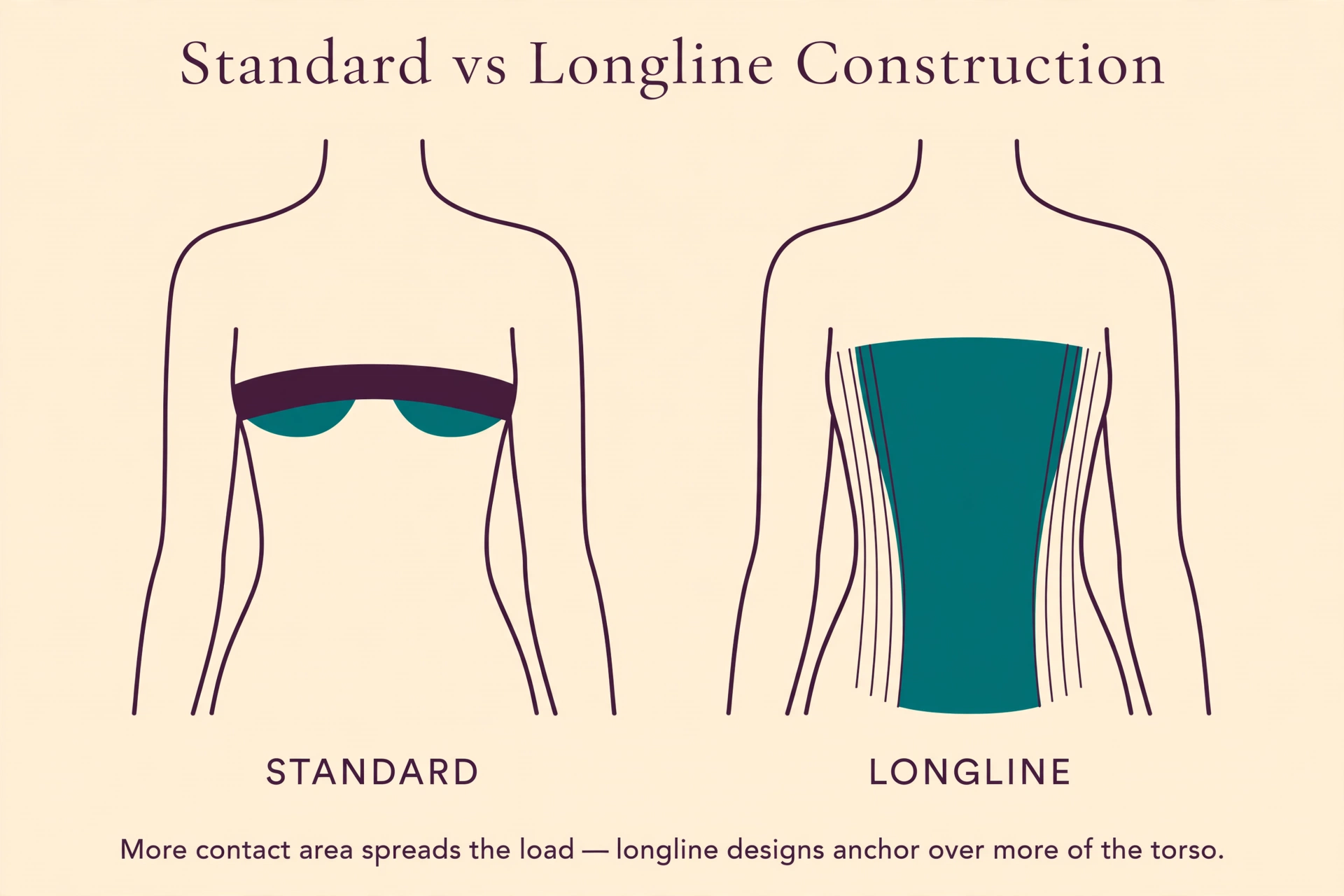
Shop construction, not claims. The checklist in the buying section below tells you exactly what to inspect. And when a standard strapless keeps failing despite correct size, the step up is a longline design: the extended band anchors over much more of the torso, spreading the load across a larger contact area instead of asking two inches of elastic to do all the work.
Cause 6: Your Skin Is Working Against the Grip
Friction is the mechanism. Anything that lubricates the skin-band interface defeats it — and the usual suspects are completely ordinary parts of a morning routine.
Signs
- The bra fits well and is in good condition, but slips on some days and not others
- Slipping is worse in heat, or after your morning routine
- The bra stays put in the evening but not during the day
The check
The skin check: body lotion or oil applied this morning? Perspiring? Both are friction killers. Silicone grippers in particular lose their tack on moisturized skin.
The fix
Moisturize the night before instead of the morning you wear strapless, and skip lotion on the torso where the band sits. On warm days, the band area needs to be as dry as the design expects — this is physics, not a product flaw. This cause is the easiest to test: change nothing about the bra, change the skin prep, and see if the slipping stops.
Cause 7: Your Outfit Is Pulling It Down
Sometimes the bra is innocent. A heavy dress bodice, a loose top that shifts, or a slippery dress lining can drag a perfectly good strapless bra downward all evening — and you’ll blame the bra for what the outfit did.
Signs
- The bra stays up fine under some clothes and slips under others
- The slipping started with a specific dress or top
- The garment’s weight visibly pulls at the bust area, or the lining is slick against the bra’s outer fabric
The check
Wear the same bra under a well-fitted, non-slippery top. If the problem disappears, it was the outfit. Also check: does the dress bodice have any structure of its own, or is the bra carrying the dress too?
The fix
Match the outfit to the bra’s limits: structured bodices share the load; heavy, loose, or slippery garments fight it. For the event at hand, fashion tape between bra and dress is a legitimate backstop. For the wardrobe, note which garments demand more from a strapless bra and choose accordingly.
Sizing Problem or Construction Problem? How to Tell
This is the question that decides whether you need a different size or a different bra entirely:
- It never stayed up, even brand new → sizing or construction mismatch. Work the diagnostic: band too loose (Cause 1), cups wrong (Cause 4), or under-built (Cause 5).
- It used to stay up and got worse → wear, not size. Elastic (Cause 2) or grip (Cause 3). Replace, don’t resize.
- It only fails with certain outfits or on certain days → external defeat. Outfit (Cause 7) or skin prep (Cause 6). The bra is fine.
- It fails everywhere, every time, despite correct size → construction (Cause 5). You need a better-engineered bra — wider band, boning, possibly longline — not another size of the same design.
The expensive mistake is re-buying the same construction in a different size, over and over. If two sizes of the same bra both fail, stop changing the size and change the bra.
What to Look for When Buying a Strapless Bra
Inspect the garment, not the marketing. Before buying, check for:
- A wide band with at least three hook columns. More band = more grip surface = more anchor. Narrow bands with one or two hooks are the first thing to reject.
- Silicone gripper strips along the inside top and bottom edges of the band. Run your finger along them — they should feel distinctly tacky, not like plain fabric.
- Side boning. Flexible stays sewn into the band’s sides keep it from rolling or folding. No boning on a strapless band is a red flag.
- Structured, molded cups with a real underwire. The cups should hold their own shape; a sturdy wire lifts and positions the bust so the band isn’t fighting loose tissue.
- Consider longline if standard strapless bras consistently fail you — the extended band spreads the anchoring load over much more torso.
- The brand’s own size chart, read properly. Strapless sizing isn’t always identical to the brand’s regular-bra sizing — check whether the brand says so, and read the chart as the decision tool it is. Our guide to reading lingerie size charts walks through exactly how.
- A workable return policy. Fit can’t be fully judged in a fitting room — you need a movement test at home (arms up, sit down, bend) to know the truth.
Bad Advice to Ignore
“Just go down a band size.” This is the most repeated strapless advice, and it’s half-right in a way that makes it dangerous. Going down a band without going up a cup shrinks the cups too — and cups that are suddenly too small push the bra down harder (Cause 4). The correct move is sister sizing: 36C → 32D keeps the cup volume while firming the band. But even sister sizing has limits: it works best when your current size is already close, and it can’t fix a wrong cup shape or a flimsy construction. And one nuance from experienced fitters: on bras with very sturdy, low-stretch bands (power mesh, heavy boning), your measured size may already be the right call — the “size down for strapless” rule was written for stretchy bands. Our guide to why bra bands ride up covers the underlying band mechanics and the sister-size logic in full.
“Tighter is always better.” Pain is not support. A band that digs, leaves lasting marks, or restricts breathing is too small — and a too-small band can actually ride and shift just like a too-loose one. Snug is the target; suffering is a different problem.
“Fashion tape will fix it.” Tape is event insurance, not a fit solution. If the bra only stays up with tape, the bra doesn’t fit — the tape is masking the cause instead of solving it.
“All strapless bras fall down — accept it.” No. A correctly sized, well-constructed strapless bra on properly prepped skin stays up. If yours doesn’t, one of the seven causes above is the reason — and now you know which one.
FAQ
Should a strapless bra feel tighter than my regular bra?
Yes — a little. With no straps sharing the load, the band has to grip harder from the start, so fitters generally advise a firmer band feel than your everyday bra. “Firmer” means snug and secure (two fingers under the band, no easy sliding) — not painful, digging, or breath-restricting. If it’s uncomfortable, that’s too far.
Can I just sister-size down for a strapless bra?
You can, but do it correctly: go down one band size and up one cup letter (36C → 32D) to keep the cup volume. Only do this when the cups already fit well — if the cups are wrong too, sister sizing disguises the real problem. And on very sturdy, low-stretch bands, your measured size may already be right.
How do I know if the elastic in my strapless bra is dead?
Stretch a section of the band and release it. Lively elastic snaps back crisply; dead elastic returns slowly or stays stretched. The history test works too: if the bra used to stay up and gradually got worse, that’s elastic (or grip) dying, not your body changing.
Do I actually need silicone grip strips?
They help, but they’re not the foundation. Think of silicone as friction assistance on top of a band that already grips through fit and tension — not as the thing holding the bra up by itself. Check that the strips exist and still feel tacky; if they’re worn smooth, they’ve stopped contributing.
Will a longline strapless bra stay up better?
Usually, yes — for a mechanical reason, not magic. The extended band creates a much larger contact area with your torso, so the anchoring load spreads instead of concentrating on two inches of elastic. If correctly-sized standard strapless bras keep failing you, longline is the logical next construction to try.
Can I wear a strapless bra all day comfortably?
Yes, if the fit and construction are right — the right size, a wide boned band, working elastic, and intact grip. Discomfort by midday is diagnostic information, not a strapless inevitability: it usually points to a too-loose band working too hard, a too-small band digging, or dead elastic.
The bottom line
A strapless bra stays up for exactly one reason: the band grips your ribcage well enough to carry the full load alone. When it falls, the cause is always somewhere in that chain — a band too loose, elastic too tired, grip too smooth, cups too wrong, construction too flimsy, skin too slick, or an outfit too demanding. Run the 60-second check, name your cause, fix that cause. The bra was never mysterious. It was just a machine with one anchor, waiting for you to read it.