An underwire that digs into your ribs can ruin a day by lunchtime — a sharp poke under your arms, a dull ache under your breasts, or a center gore grinding into your sternum. And the advice you’ll find online is mostly one of three things: “go up a cup,” “bend the wire,” or “just accept that underwires hurt.” Two of those are sometimes wrong, and the third is a myth.
Here is what fitters actually agree on: a correctly fitted underwire should rest on your ribcage — not on your breast tissue — and it should not hurt. When it digs, something specific is wrong: the wire is the wrong width, the cups are too small, the band is misbehaving, the shape doesn’t match your body, or the bra is worn out. This guide diagnoses which one is yours.
The method: Cause → Signs → Check → Fix. Start with the 60-second diagnostic below — most readers will identify their likely cause there, then read only the matching section.
What Your Underwire Is Supposed to Do
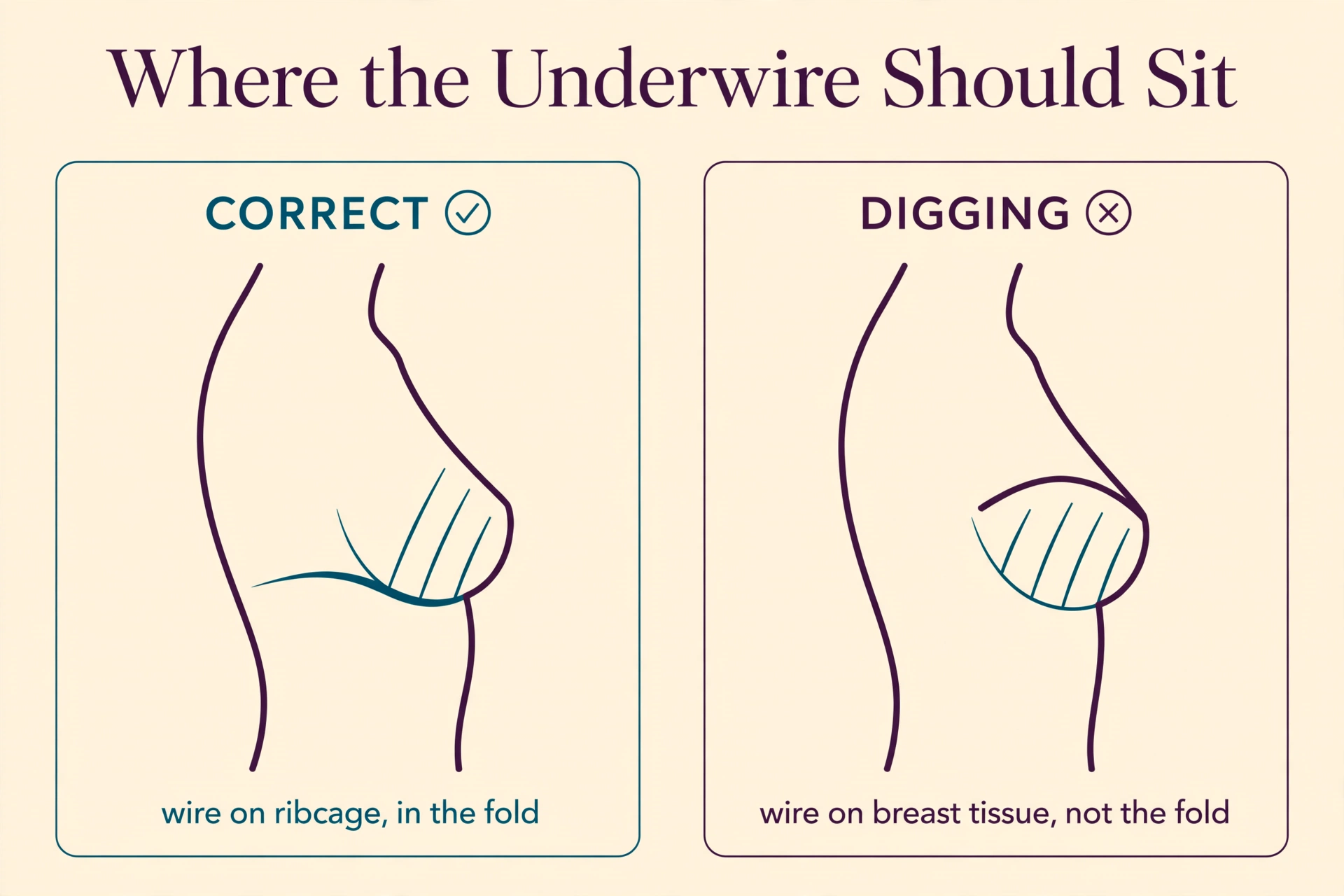
Before diagnosing, you need the baseline. An underwire has one job: trace the boundary where your breast meets your chest — the crease underneath each breast, called the inframammary fold — and rest flat against your ribcage along that line. It should encircle your breast root (the base where breast tissue attaches to the chest), sitting on bone and rib, never on soft breast tissue. Fitters at Bravissimo put it plainly: wires should never, ever sit on breast tissue (via Woman & Home’s fit guide).
That single rule explains nearly every digging complaint. Pain happens when the wire ends up somewhere it doesn’t belong: on breast tissue instead of ribcage, jammed into the sternum, or poking toward the armpit. The rest of this guide is about why it ended up there.
The 60-Second Diagnostic
Pay attention to where the wire hurts. Location is not a guaranteed diagnosis — but each location is more consistent with certain causes than others. Find your pattern, then read the matching cause.
- Pain at the outer sides, near the armpits. The wire ends are the suspects. If the wire feels like it’s stabbing into soft tissue at the sides, the wire is likely too narrow for your breast root. If instead it pokes outward toward your armpit, the wire may be too wide. → Cause 1.
- Pain directly underneath the breast. The wire is probably sitting on breast tissue instead of in the fold — most consistent with cups too small pushing the wire upward. → Cause 2.
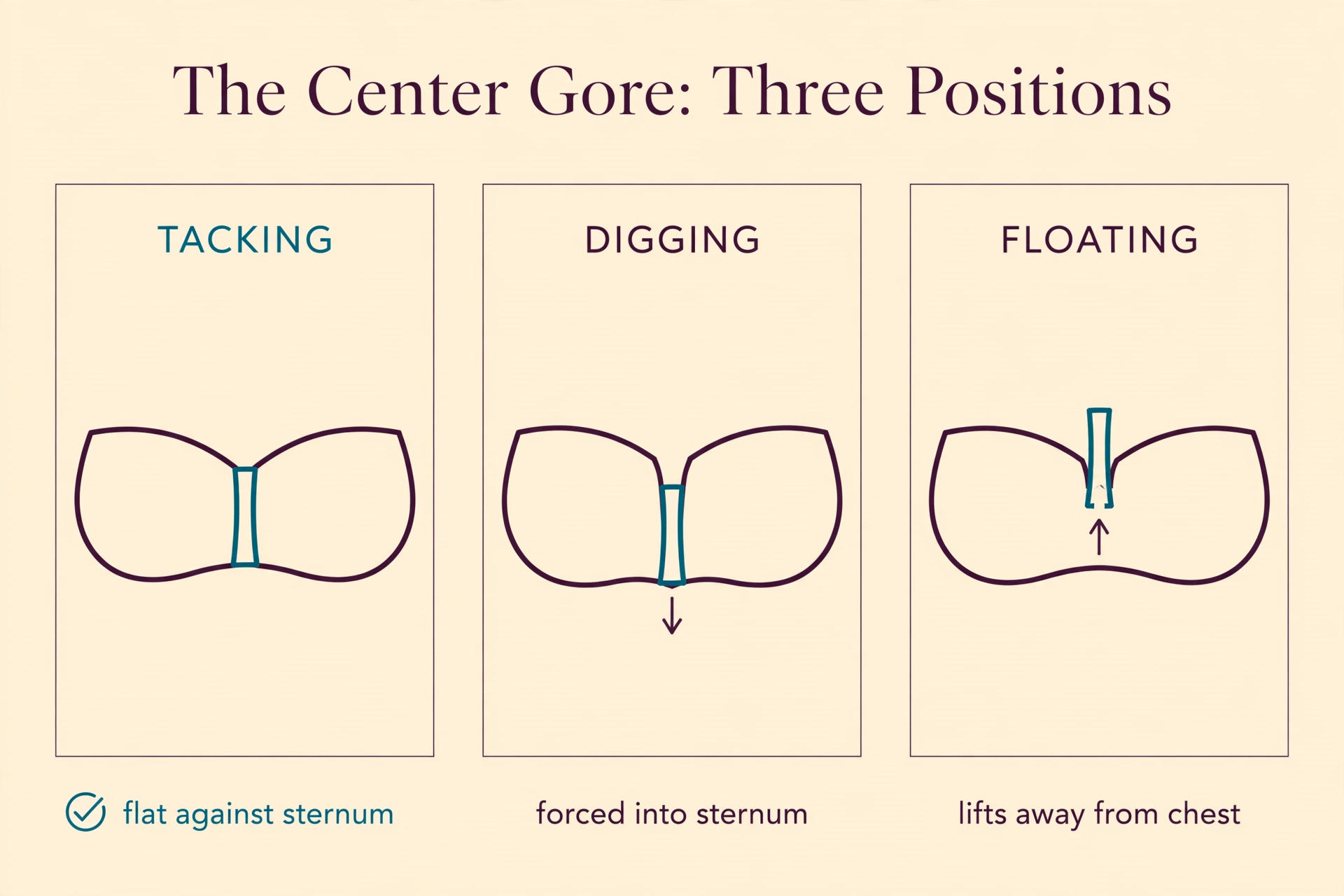
- Pain at the center, where the gore meets your sternum. Two opposite possibilities: the gore is being forced into your chest (band too tight), or the gore floats away from your chest while the wire edges dig (cups too small). Press the gore: if it’s jammed hard against you, think Cause 4; if it hovers in the air, think Cause 2. → Causes 2 or 4.
- Pain that starts the moment you put the bra on. An immediate complaint points to a clear mismatch — wrong wire width, wrong cup size, or wrong shape. The bra never had a chance.
- Pain that builds over hours. A bra that feels fine at 8 a.m. and hurts by 3 p.m. is more consistent with a marginal fit being defeated by movement (band riding up — Cause 3), or a bra that’s wearing out (Cause 6).
- Pain only when sitting or bending. If standing is fine but sitting hurts, the wire may be too long for your torso — it has nowhere to go when you fold. Shorter-wire styles (demi cups) exist for exactly this. → Cause 5.
- Pain on one side only. Check that side’s wire for bending or distortion first (Cause 6) — a single bent wire is a common one-sided culprit. Natural asymmetry between breasts can also mean one side fits worse; that’s ordinary, not a flaw.
Now the causes, each with signs, a check, and a fix.
Cause 1: The Wire Is the Wrong Width for Your Breast Root
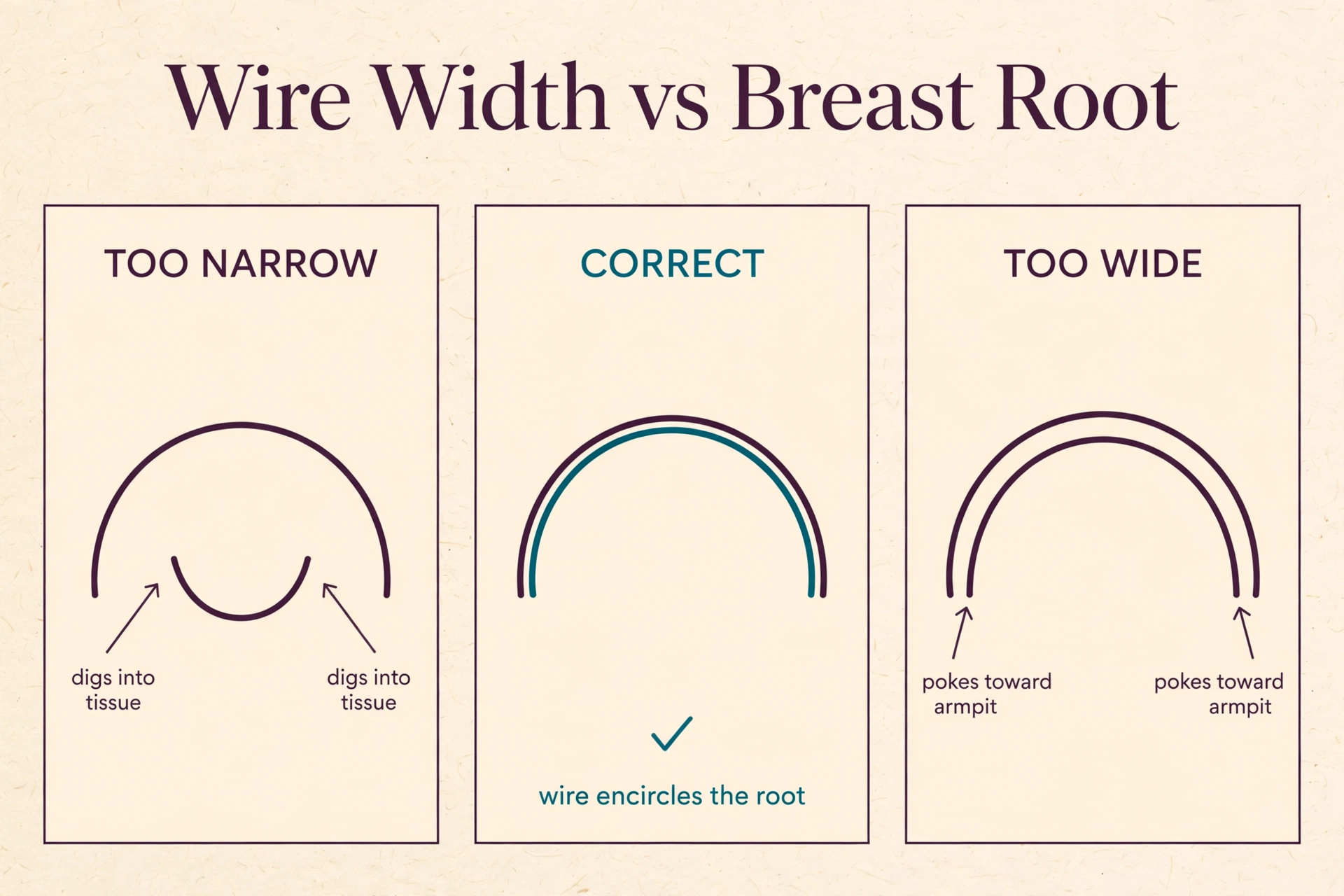
Your breast root — the base where breast tissue attaches to your chest — has a width. The underwire has a width. When those two don’t match, the wire cannot sit where it belongs, and its ends become pressure points.
Too narrow: the wire ends land on soft breast tissue at the sides instead of encircling it. Every fitter source names this pattern: the wire tip digs into side tissue, sometimes leaving marks or bruising with long wear. Retailer HerRoom’s fit guide states it directly — if the wire diameter is too small, the underarm end pokes breast tissue.
Too wide: the wire extends past the breast root toward the back, and the ends poke into the armpit area. Same source, opposite direction: if the diameter is too large, the underarm end pokes into the armpit.
This is a shape problem more than a size problem — and it’s why “just go up a cup” often fails here. A larger cup on the same wire family may still carry the same too-narrow wire.
Signs
- Sharp, localized pain at the wire ends near the sides/underarms
- Red marks or indentations exactly where the wire tips sit — on soft tissue, not on rib
- The pain is worst at the sides, not underneath the breast or at the center
The check
With the bra on, press a fingertip along the wire from center to side. You should feel the wire pass from the center, under the breast, and end on firm ribcage past the breast tissue. If your finger meets soft breast tissue at the wire’s end, the wire is too narrow. If the wire clearly extends well past where your breast tissue ends and toward your armpit, it’s too wide.
The fix
You need a different wire, which usually means a different bra — wire width varies by brand and style, not just by size. When trying replacements, compare wire widths directly: some brands run notably wider or narrower in the same nominal size. Full-coverage and seamed cups often carry wider wires than plunge styles in the same brand. This is a construction hunt, not a size tweak.
Cause 2: The Cups Are Too Small
The most commonly cited reason across fitter sources — and the mechanism is straightforward. When the cups can’t contain your breast tissue, the tissue has nowhere to go, so it pushes the whole bra forward and upward. The underwire, which should sit in the fold, gets shoved up onto the breast itself. Then it digs — because it’s pressing on soft tissue instead of resting on ribcage.
Signs
- Spillage over the top, sides, or center along with the wire pain
- The wire sits visibly on breast tissue rather than underneath it
- The center gore floats away from your chest instead of lying flat (the tissue is pushing the cups — and the gore — forward)
- Scooping all your tissue into the cups (“scoop and swoop”) makes it worse, not better — there’s simply no room
The check
Bend forward at the waist. If tissue spills or the wire clearly rides on breast rather than under it, the cups are too small. Also check the gore: a floating gore (hovering off your sternum) with wire pain underneath is the classic too-small-cups signature — the cups are being pushed forward off the chest wall.
The fix
Go up in cup volume — keeping the band the same if the band fits (36C → 36D). If the band also needs to change, use a proper sister size so you don’t trade one problem for another (more on this below). And note the boundary: if larger cups still leave the wire digging at the sides, you’ve likely got Cause 1 (wire width) riding along with — or instead of — this one.
Cause 3: The Band Is Too Loose
A loose band can’t anchor the bra, so the whole structure migrates upward during the day — and it drags the underwire up with it. The wire ends up sitting on breast tissue instead of in the fold, and it digs. This is the same ride-up mechanics our band-fit guide covers: a band that can’t grip the ribcage travels toward where the torso is narrower.
Signs
- The wire pain gets worse as the day goes on (fine in the morning, digging by afternoon)
- The back band creeps upward while the front drops
- You’re on the tightest hooks and it still feels loose
- The wire was in the right place when you put the bra on and isn’t anymore
The check
The arms-up test: raise both arms overhead. If the band jumps up and the wires lift off the fold, the band is too loose to hold the structure down. Also the two-finger test at the back — more than two fingers sliding in easily means the band isn’t gripping.
The fix
Go down one band size and up one cup letter together (36C → 34D) so the cup volume stays the same while the band firms up. Our guide to why bra bands ride up covers the band-as-anchor mechanics in full — the same physics is moving your underwire off its mark here.
Cause 4: The Band Is Too Tight
The mirror image of Cause 3 — and just as real. A too-tight band pulls the entire bra framework taut like a drumhead, and the center gore gets forced into the sternum. The wire doesn’t need to be misplaced to hurt here; it’s being driven into you by band tension.
One important nuance from experienced fitters: many “my band is too tight” complaints are actually too-small cups in disguise — when the cups can’t hold the tissue, the whole bra feels tight and the band takes the blame. So before concluding the band is too small, check Cause 2 first. If the cups genuinely fit and the gore still grinds into your sternum, the band is the culprit.
Signs
- Pain concentrated at the center front, where the gore presses the sternum
- Deep red marks from the band itself, all the way around
- The bra feels restrictive — hard to take a full breath comfortably
- The gore is jammed flat and hard against you, not just touching
The check
Press the gore: if it’s being forced into your sternum with real pressure (not merely touching), and the band leaves deep marks, the band is too tight. Contrast with Cause 2’s floating gore — opposite symptom, opposite fix.
The fix
Go up one band size — and down one cup letter at the same time to keep the cup volume (32DD → 34D). If the cups were already too small, fix the cups first; a band that feels tight because of tiny cups needs a cup change, not a band change.
Cause 5: The Gore or Wire Shape Doesn’t Match Your Body
Sometimes the size is right and the shape is wrong. Bras are cut to averaged proportions, and bodies that differ from the average get wires in the wrong places.
- Close-set breasts + high gore: if your breasts sit close together with little space between them, a tall, wide center gore has nowhere to go — it presses into tissue or sternum. The fix fitters reach for is a lower, narrower gore: plunge styles exist largely for this.
- Wide-set breasts + standard gore: the reverse — wires can jab at the outer edge of the breast while the center gapes. A wider gore, or a shorter-wired demi style, often sits better here.
- Short torso / petite frame: long wires that are fine on an average torso can poke under the arms on a shorter one. Retailer HerRoom notes this directly: women short in stature often find underwires poking under their arms, and demi-cup bras — with shorter wires — are the instant fix.
- Wire curve vs. ribcage curve: wire shapes differ between brands — some run more U-shaped, others narrower or more open. If the wire’s curve fights your ribcage’s curve, no size in that brand will sit right.
Signs
- The size seems right (band grips, cups contain) but a specific spot still digs
- Pain is oddly localized: dead center, or far out at the sides under the arms
- You’ve tried multiple sizes in the same style with the same complaint
- A different brand’s bra in the same nominal size feels fine
The check
Map the pain: center-front grinding with close-set breasts → gore height; outer-edge jabbing with wide-set breasts → wire spread; underarm poking on a petite frame → wire length. Then try a different shape — plunge, demi, or a different brand’s wire — rather than a different size.
The fix
Change the construction, not the size. Plunge for close-set, wider gore or demi for wide-set, demi for short torsos, a different brand for a different wire curve. “This specific shape is not compatible with my body” is a legitimate conclusion — and cheaper than another round of size roulette.
Cause 6: The Bra Is Worn Out
Underwires don’t last forever. With wear and washing, three things happen: the elastic dies so the band stops anchoring (hello, Cause 3 by another route), the wire itself distorts from its engineered curve, and the wire can migrate inside — or break through — its fabric channel. A distorted wire no longer traces the fold; it traces wherever the damage put it, and it digs there.
Retailer guidance puts a frequently-worn bra’s life around six months — after that, structural failure is normal, not a defect.
Signs
- The bra used to fit without pain and gradually got worse
- The wire looks bent, kinked, or visibly off its original curve when you lay the bra flat
- The wire has poked through the fabric at the sides or center — or you can feel it shifting inside the channel
- Pain on one side only, on a bra that used to be fine — a single migrated wire is the classic one-sided culprit
The check
Lay the bra flat and sight along each wire: it should trace a smooth, symmetrical U. Kinks, asymmetry between the two sides, or a wire you can slide around inside its channel all mean the structure has failed. If the wire has broken through the fabric, that bra is done — there’s no safe home repair that restores the engineered shape.
The fix
Replace it. And extend the next bra’s life: rotate between bras so each rests between wears, wash in a mesh bag (never the dryer — heat kills elastic and warps wires), and fasten the hooks before washing so wires don’t snag and bend.
Cause 7: Your Ribcage Geometry
Here’s the uncomfortable exception to the “it’s always the fit” story: sometimes the bra fits and the wire still digs — because of what’s underneath it. Some people have a prominent rib sitting exactly where the underwire wants to lie. Fitter Linda the Bra Lady, widely quoted in fitting communities, describes the test: press your finger directly under your breasts where the wire would sit — if you feel a hard bump there, you have a rib right underneath the wire’s path.
This doesn’t mean you’re shaped wrong. It means the standard wire path crosses a bony prominence on your body, and a standard bra can’t route around it.
Signs
- Multiple bras in the right size, from different brands, all dig in the same spot
- You can feel a distinct rib bump exactly under the wire’s path with your finger
- The pain is precisely localized — a single point, not a general misfit
The check
The finger test above, done without a bra on. If there’s a hard prominence exactly where every wire lands, that’s your answer — it’s anatomy, not sizing.
The fix
This is a construction hunt with a specific target: wires with more flexible casings, lower-profile wire shapes, or styles whose wire path sits slightly differently (plunge and demi styles route the wire differently at the front and sides). Some people in this situation ultimately prefer wire-free styles — and that’s a legitimate endpoint, not a failure. What you should not do is keep buying the same wire shape in new sizes expecting a different result.
Sizing Problem or Construction Problem? How to Tell
This is the question that decides whether you need a different size or a different bra. Work it in order:
- Wire on tissue at the sides, cups otherwise fine → construction (wire width). A new size in the same bra won’t change the wire. → Cause 1
- Spillage + wire on tissue + floating gore → sizing (cups too small). → Cause 2
- Fine in the morning, digging by afternoon, band riding up → sizing (band too loose) — or wear. → Causes 3, 6
- Gore jammed into sternum, band leaving deep marks → sizing (band too tight) — after ruling out tiny cups. → Cause 4
- Right size, wrong spot, brand B works where brand A doesn’t → construction (shape). → Cause 5
- Used to be fine, now digs → wear. → Cause 6
- Right size, right shape, same spot on every bra, bony bump underneath → anatomy. → Cause 7
The expensive mistake — the one this whole guide is trying to prevent — is re-buying the same construction in a different size, over and over. If two sizes of the same bra both dig in the same place, stop changing the size and change the bra.
A Note on Sister Sizing
Sister sizing (trading band and cup against each other to keep volume — 36C → 34D) comes up constantly in wire-pain discussions, and it’s a real tool — but only when used for the right reason. Going down a band and up a cup firms the band without shrinking the cups: the correct move for Cause 3. Going up a band and down a cup loosens the band without growing the cups: the correct move for Cause 4.
What sister sizing cannot do: change wire width (Cause 1), change gore height (Cause 5), or fix a worn wire (Cause 6). And changing band size while pretending nothing else changed is the classic error — cup volume stays the same only if you move the cup letter in the opposite direction. Our guide to reading lingerie size charts walks through the brand’s own chart as the decision tool for exactly these moves.
What to Look for When Buying
Inspect the garment, not the marketing. Before buying, check:
- Wire width against your root. You can’t measure this off a size chart — but you can compare: hold a new bra’s wire against a bra whose wire never dug. Wider or narrower tells you which direction your root needs.
- Cup construction for your shape. Seamed, multi-part cups follow varied breast shapes better than a single molded cup; molded cups suit the shape they were molded for and punish deviation.
- Gore height for your spacing. Close-set breasts → lower, narrower gore (plunge). Wide-set → standard or wider gore. Try both and trust the mirror.
- Wire length for your torso. If wires poke under your arms when you sit, look at demi styles with shorter wires.
- Band firmness on the loosest hook. A new bra should grip firmly on the loosest setting — that’s your adjustment reserve as the elastic ages.
- The brand’s own size chart, read properly. Wire shapes and cup gradings differ between brands; the chart is the starting point, not the verdict. Our guide to reading lingerie size charts shows how to use it as a decision tool.
- A workable return policy. Wire comfort can’t be judged in a fitting room in ninety seconds — you need hours of wear, including sitting, to know the truth.
Bad Advice to Ignore
“Just bend the wire until it stops hurting.” This is the internet’s favorite wire fix — the top-ranking personal blog for this problem recommends bending wire ends on a tabletop. Treat it with skepticism: an underwire is a tempered piece of metal sewn into a shaped channel. Bending it by hand weakens the metal, risks cracking its coating, and can create a new pressure point somewhere else — all without fixing the mismatch that caused the digging. It sometimes feels like it works because you’ve moved the pressure point, not removed it. If the wire shape is wrong for you, the fix is a different wire shape, not a reshaped one.
“Just go up a cup size.” The most repeated advice, and genuinely correct when the cups are too small (Cause 2). But it’s prescribed for everything — including wire-width mismatch (Cause 1), where a bigger cup on the same wire changes nothing, and band problems (Causes 3–4), where it changes the wrong thing. Diagnose first, resize second.
“Take the wire out.” Removing the wire destroys the bra’s structure — the wire is load-bearing, not decorative. A wire-free bra is a legitimate choice; a de-wired bra is a broken one.
“Underwires just hurt — accept it.” No. A correctly fitted underwire rests on your ribcage and shouldn’t cause pain. Persistent digging is diagnostic information, not a tax on wearing underwires. (And if you’ve genuinely tried correct fit in multiple constructions and the pain persists, read the safety note below instead of suffering.)
A Short Safety Note
Most underwire pain is a fit problem — but not all pain should be automatically blamed on the bra. If pain persists after you remove the bra or switch to a completely different style, is severe, or comes with a lump, skin change, swelling, injury, or breathing symptoms, get it evaluated medically rather than continuing to troubleshoot fit. This guide diagnoses garment problems; it doesn’t diagnose bodies.
FAQ
Is it normal for an underwire to hurt?
No. A correctly fitted underwire rests on your ribcage in the fold under your breast — it makes contact, but it shouldn’t dig or cause pain. Persistent digging is a fit or construction problem with a specific cause, not something to accept.
Should the underwire touch my ribs at all?
Yes — it’s supposed to rest on your ribcage. The distinction that matters is what it’s touching: flat against rib bone in the inframammary fold is correct; pressing into soft breast tissue is not. Contact without pain is the target.
Can I just bend the wire so it stops digging?
It’s not recommended. Hand-bending weakens the wire, risks cracking its coating, and usually just moves the pressure point rather than removing it. If the wire shape is wrong for your body, replace the bra with a different wire shape instead of reshaping the wrong one.
Will going up a cup size fix wire digging?
Only if the cups are genuinely too small (spillage, wire riding on tissue, floating gore). It won’t fix a wire that’s too narrow for your breast root, a band problem, or a shape mismatch — diagnose the cause first, then decide whether the size needs to change at all.
Why does only one side hurt?
Check that side’s wire first — a single bent, kinked, or migrated wire is the most common one-sided culprit. Natural asymmetry between breasts can also mean one side fits worse than the other; that’s ordinary. If one side is consistently painful across multiple bras, fit to the more demanding side.
When should I see a doctor about bra pain?
If pain persists after removing the bra or switching styles entirely, is severe, or is accompanied by a lump, skin changes, swelling, or breathing symptoms — get evaluated medically. Fit troubleshooting is for pain that clearly comes from the garment.
The bottom line
An underwire digs for a reason, and the reason is almost always findable: the wrong wire width, cups too small, a band too loose or too tight, a shape mismatch, a worn-out bra — or, occasionally, a ribcage that no standard wire was routed for. Locate the pain, run the check, name the cause, fix that cause. And when the digging persists after the bra comes off or brings alarming symptoms with it, stop troubleshooting fit and get checked. The wire was never supposed to hurt. Now you know how to make it stop.
3 thoughts on “Why Does Your Underwire Dig Into Your Ribs? (7 Causes and How to Fix Each)”
Comments are closed.