Most lingerie fit problems don’t start in the fitting room. They start on the product page, in the thirty seconds a shopper spends staring at a size chart, comparing numbers to a tape measure, and guessing.
The chart looks authoritative. Rows of numbers, neat columns, a reassuring grid. But a size chart is not a verdict — it’s a decision tool, and like any tool, it only works if you know what it’s actually measuring, which numbers matter for the garment you’re buying, and what to do when the numbers refuse to agree with each other.
This guide teaches you to use any lingerie size chart as a decision tool. The framework has four steps:
CHART → PRIORITIZE → CONVERT → DECIDE
Step 1 — CHART: Figure out what you’re actually looking at
Before you compare a single number, read the chart itself. Most charts fall into one of six types, and each type answers a different question:
| Chart type | What it shows | What it can’t tell you |
|---|---|---|
| Body measurement chart | The body measurements each size is designed for | Whether the garment runs tight or relaxed on that body |
| Garment measurement chart | The physical dimensions of the garment itself | How those dimensions translate to your body without knowing ease/stretch |
| Alpha chart (XS–XL) | Letter sizes mapped to measurement ranges | Precision — ranges are wide and vary wildly between brands |
| Numeric chart (2–16, 32–44) | Number sizes mapped to measurement ranges | Same as alpha, with false precision — a “10” is not a universal constant |
| Bra chart (band + cup) | Underbust ranges and bust-minus-underbust differences | Anything about non-bra garments; cup letters aren’t comparable across brands without the chart |
| International conversion chart | How this brand maps its sizes to other countries’ systems | Whether the fit is actually equivalent — it maps labels, not bodies |
Two distinctions do most of the work:
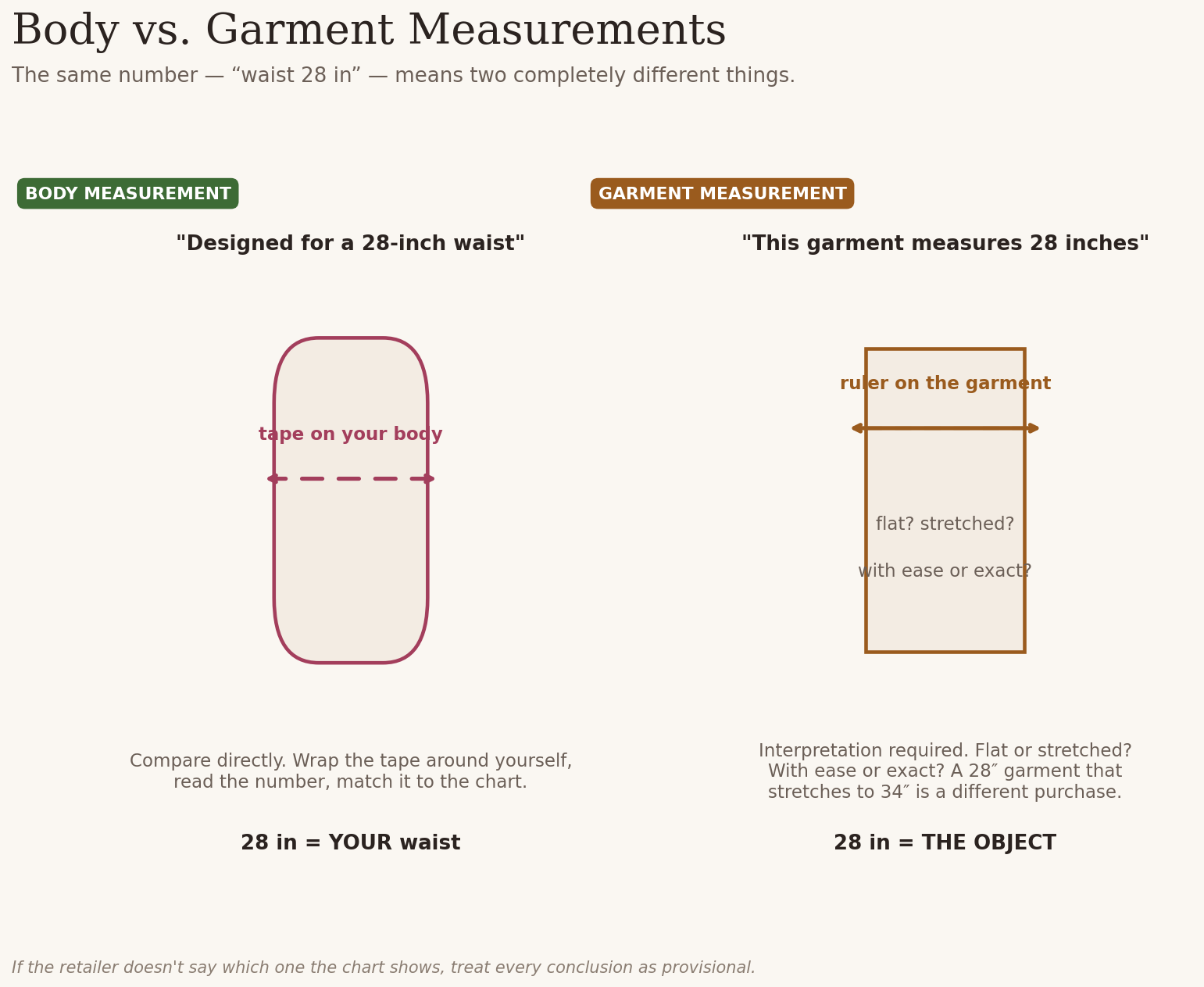
Body vs. garment measurements. A body measurement chart says “a size M fits a 28–30 inch waist.” A garment measurement chart says “the size M waistband measures 26 inches unstretched.” These are different claims. If the chart doesn’t say which it is — and many don’t — treat every conclusion as provisional.
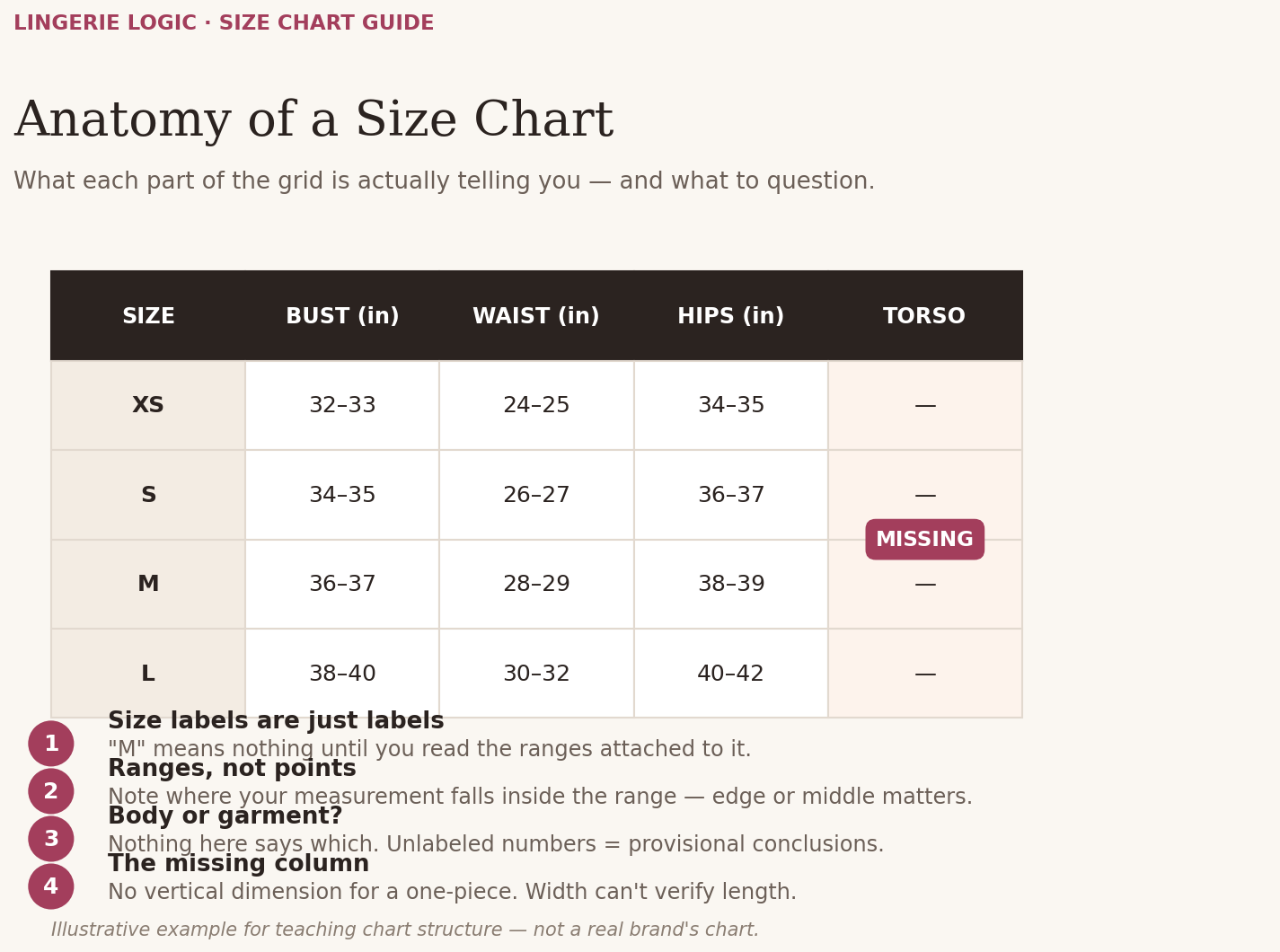
What the chart omits is information too. A bodysuit chart with no torso or girth column isn’t telling you torso length doesn’t matter; it’s telling you the brand chose not to publish it. The missing dimension protocol in Step 4 handles exactly this.
Step 2 — PRIORITIZE: Not every number matters equally
A size chart hands you five or six measurements. For any given garment, only one or two of them actually drive the fit decision. The rest are supporting data. Prioritize by asking: which dimension, if wrong, makes the garment unwearable?
Bodysuits and teddies: torso length (or girth) is the priority dimension. A bodysuit that fits your bust and hips but is two inches short in the torso will ride up, pull at the shoulders, and strain the snaps — every wear. Width measurements are secondary because knit fabrics forgive width; nothing forgives a short torso loop. If you’ve lived this problem, our bodysuit ride-up guide diagnoses each cause.
Chemises and babydolls: bust and sweep (the hem circumference) matter most. Length matters if you’re between heights, but these garments are cut to skim, not to anchor — the fit decision is about whether the bust is supported (or deliberately unsupported) and whether the skirt falls cleanly. Our chemise vs. babydoll breakdown covers how the two silhouettes use these dimensions differently.
Separates (bra + panty sets, bralettes + briefs): each piece gets its own decision. The bra follows bra rules (band first — if the band rides up, nothing else about the fit can be trusted); the panty follows waist/hip. Never let a good bra measurement rescue a bad panty measurement or vice versa.
Structured or underwired pieces: the bust dimension is non-negotiable. Stretch forgives; underwire doesn’t. When in doubt on a structured garment, the bust measurement outranks comfort preferences.
Step 3 — CONVERT: International sizes without the fairy tales
Cross-border shopping adds a translation layer, and this is where most size-chart errors happen. The rule is simple: convert through the brand’s own chart, never through a universal table.
A “universal” US-to-UK-to-EU conversion table assumes every brand grades its sizes identically. They don’t. A US 34D from one brand can be cut differently from a US 34D from another, and their UK equivalents diverge accordingly. The brand’s own conversion chart accounts for its own grading; a generic table cannot.
Three conversion realities worth internalizing:
- Band numbers are not universal either. A 34 band is nominally a 34-inch underbust, but brands differ in how much ease they build in and whether they expect you to measure snugly or loosely. The number is a label for a range, not a measurement of your body.
- Cup letters diverge after D across systems. US and UK cup progressions use different letters for the same volumes past D. Don’t convert from memory — read the brand’s chart row for your measurements and take whatever letter it gives you.
- Alpha sizes are the least portable. An “M” in a US juniors’ line, a European 38, and a UK 10 are three different grading traditions wearing similar-looking labels. Convert the measurements, not the letters.
Practical method: take your measurements, find them on the brand’s native chart first (whatever country system it uses), note the size, then — and only then — use that same brand’s conversion column to find the label in your system. If the brand publishes no conversion chart, you don’t have a conversion — you have a guess. Treat it as one.
Step 4 — DECIDE: Rules for when measurements span two sizes
This is the moment the framework exists for. Your bust says M, your waist says S, your hips say M. Now what? Work through these questions in order — stop at the first one that resolves it:
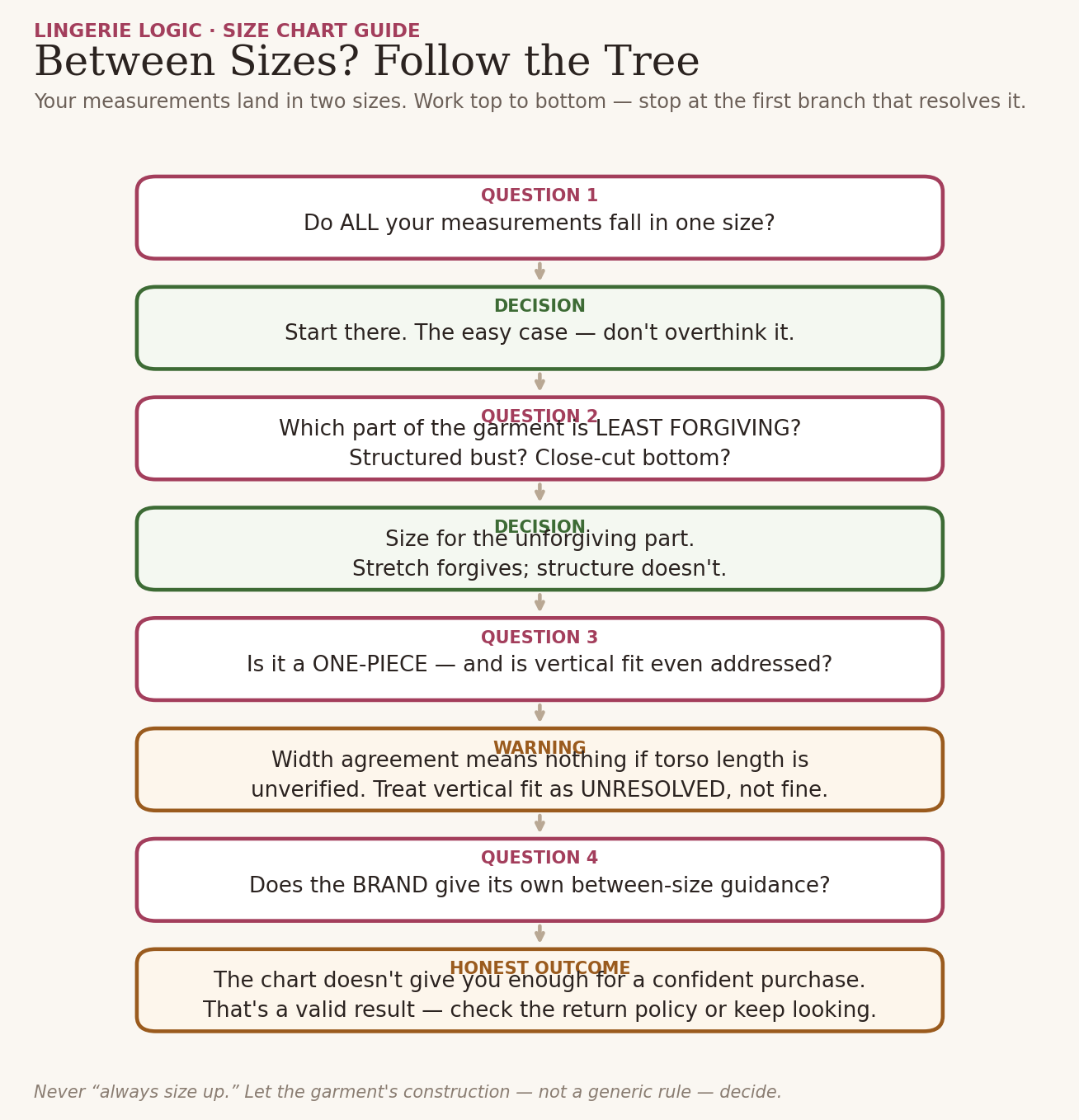
Question 1: Do all your measurements fall in one size? Then that’s your size. The easy case — don’t overthink it.
Question 2: Which part of the garment is least forgiving? Size for the unforgiving part. Structured bust over stretchy skirt. Close-cut bottom over relaxed top. The logic: fabric with stretch or ease can accommodate being slightly off; boning, underwire, and non-stretch closures cannot.
Question 3: Is it a one-piece, and is vertical fit even addressed? For bodysuits and teddies, if the chart gives you no torso data, width agreement means nothing — you cannot verify the dimension most likely to ruin the fit. This is the missing-dimension protocol: treat vertical fit as unresolved, not as fine.
Question 4: Does the brand give its own between-size guidance? Some brands publish “if between sizes, size up/down” notes. Brand-specific guidance outranks generic rules because it’s calibrated to that brand’s grading and fabric.
If nothing resolves it: the chart doesn’t give you enough information for a confident purchase. That’s a valid result, not a failure. Check the return policy, order both sizes if returns are free, or keep looking.
What never works: “always size up” as a universal rule. Sizing up on a structured bust creates gaping; sizing down on a high-stretch bodysuit creates ride-up. Let the garment’s construction decide, not a slogan.
The missing-dimension protocol
When the chart omits a dimension you need, run this:
- Name the missing dimension (torso length for a bodysuit, cup capacity for a “bust: S/M/L” chemise, length for a longline piece).
- Ask whether the garment’s construction makes that dimension load-bearing. Torso length on a snap-crotch bodysuit: load-bearing. Hem length on a babydoll: decorative.
- If load-bearing and unpublished: look for proxy data — model measurements (“model is 5’9″ and wears S”), customer reviews mentioning height/torso, or the brand’s general fit notes.
- If no proxy data exists: the purchase is a gamble. Price the gamble honestly: free returns make it a reasonable experiment; final sale makes it a pass.
What S/M/L actually means (and doesn’t)
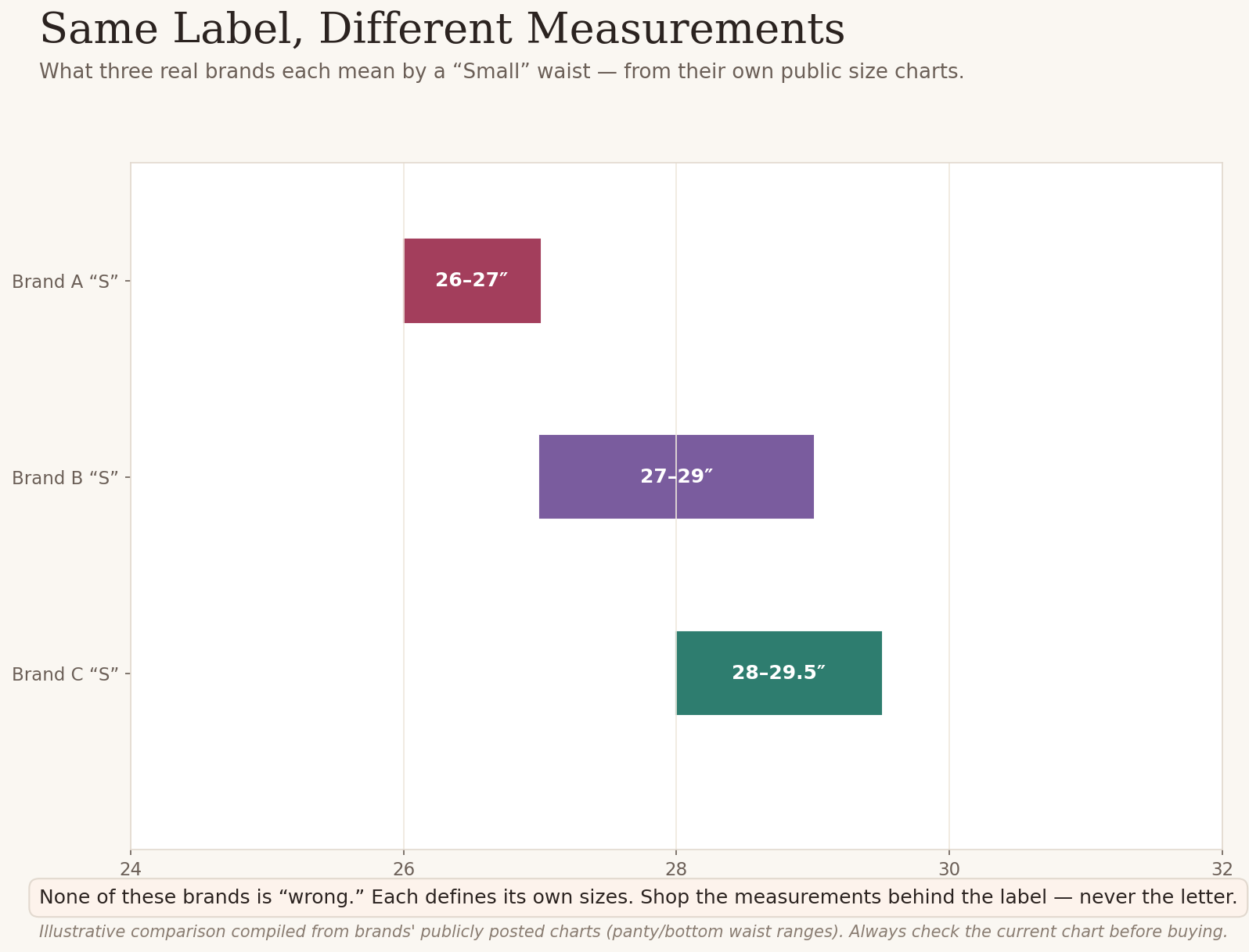
Alpha sizes are ranges, not measurements. “Small” is a label a brand attaches to whatever measurement range its grader chose — and graders choose differently. Three real brands’ published charts define a “Small” waist as 26–27″, 27–29″, and 28–29.5″ respectively (panty/bottom ranges; illustrative comparison). None of them is wrong. They’re just not speaking the same language, which is why shopping the letter instead of the measurements is the single most common size-chart error.
The letter is a filing system. The numbers are the information. Read the numbers.
The 10-point product-listing checklist
Before you buy, the listing should answer these. Every “no” is uncertainty you’re accepting:
- Does the chart say body or garment measurements?
- Are units stated (inches vs. cm)?
- Is there a separate chart for this garment type, or one generic chart for everything?
- For one-pieces: is torso/girth published?
- For structured busts: are band and cup separated, or collapsed into S/M/L?
- Is there an international conversion chart from this brand (not a generic one)?
- Does the brand publish between-size guidance?
- Are model measurements given (height + size worn)?
- Is fabric composition and stretch stated?
- Is the return policy acceptable for the remaining uncertainty?
FAQ
How do I read a lingerie size chart if my measurements fall between sizes?
Prioritize the least forgiving dimension first — structured bust over stretchy skirt, close-cut bottom over relaxed top. If the brand publishes its own between-size guidance, follow that over any generic rule. If nothing resolves it, treat the chart as insufficient and check the return policy before ordering.
Should I size up or down in lingerie when between sizes?
Neither, as a rule. “Always size up” creates gaping in structured busts; “always size down” creates ride-up in stretch bodysuits. Let the garment’s construction decide: size for the part with the least stretch and structure you can’t adjust.
Are lingerie size charts based on body or garment measurements?
Either — and many charts don’t say which. A body chart lists the measurements the size is designed for; a garment chart lists the physical dimensions of the piece. If the listing doesn’t specify, treat every conclusion as provisional.
Why does a Small fit differently across lingerie brands?
Because “Small” is a label, not a measurement. Each brand’s grader assigns its own ranges to each letter — published charts show Small waists ranging from 26–27″ to 28–29.5″ across brands. Shop the numbers behind the letter, never the letter alone.
How do I convert lingerie sizes between US, UK, and EU?
Convert through the brand’s own chart, never a universal table. Find your measurements on the brand’s native sizing first, then use that same brand’s conversion column. Cup letters diverge after D across systems, so don’t convert from memory.
What if the size chart is missing a measurement I need, like torso length?
Run the missing-dimension protocol: name the missing dimension, decide whether the garment’s construction makes it load-bearing, look for proxy data (model measurements, reviews), and if nothing exists, price the gamble honestly — free returns make it an experiment, final sale makes it a pass.
The bottom line
A size chart is a decision tool with four moves: read what type of chart you’re looking at, prioritize the measurements that actually drive fit for that garment, convert through the brand’s own system, and decide between sizes by construction — not slogans. And when the chart can’t support a confident decision, saying so is the smartest move on the page.
6 thoughts on “How to Read a Lingerie Size Chart (and What to Do When Your Measurements Disagree)”
Comments are closed.