A waistband that folds over itself is one of the most annoying fit failures in everyday underwear — and one of the most misdiagnosed. The advice online usually collapses into a single slogan (“they’re too small” or “they’re too big”), but a rolling waistband has several mechanically different causes, some of which call for opposite responses. This guide separates them the way a fitter would: by observable behavior first, then by a comparison test that actually isolates the cause instead of guessing at it.
Quick answer
A panty waistband usually rolls down for one of four garment-side reasons: the size is off (the direction with the clearest panty-specific support is too large), the band is seated away from the position the rise was designed for, the waistband construction itself is prone to folding, or the elastic has lost recovery through wear and washing. Rolling that happens mainly when you sit or move is usually movement exposing one of those issues rather than a separate cause. The behavior tells you where to look; a simple comparison test — a fresh pair, an adjacent size, or a different rise — tells you which cause you actually have. If your problem is the panty creeping up at the back instead, that is a different fit issue (coverage and leg-opening geometry) and is not covered here.
The 60-second isolation check
Before changing anything, run these three quick observations:
- Placement reset. Put the pair on and seat the waistband where that rise was designed to sit — not pulled up higher out of habit. HerRoom’s fitting guide notes that the most common placement mistake is pulling panties up like trousers, which seats the waistband higher than it was designed to rest.
- Stand → walk → sit → stand. Wear the pair through one normal cycle. Note when the rolling starts: immediately, only after sitting, or only after hours of wear.
- Note the pattern. Does it roll mainly at the front, around most of the band, only when you sit or move, or did it start only after the pair had been worn and washed for a while?
Those observations feed the router below. None of them proves a cause on its own — each one tells you which comparison test to run first.
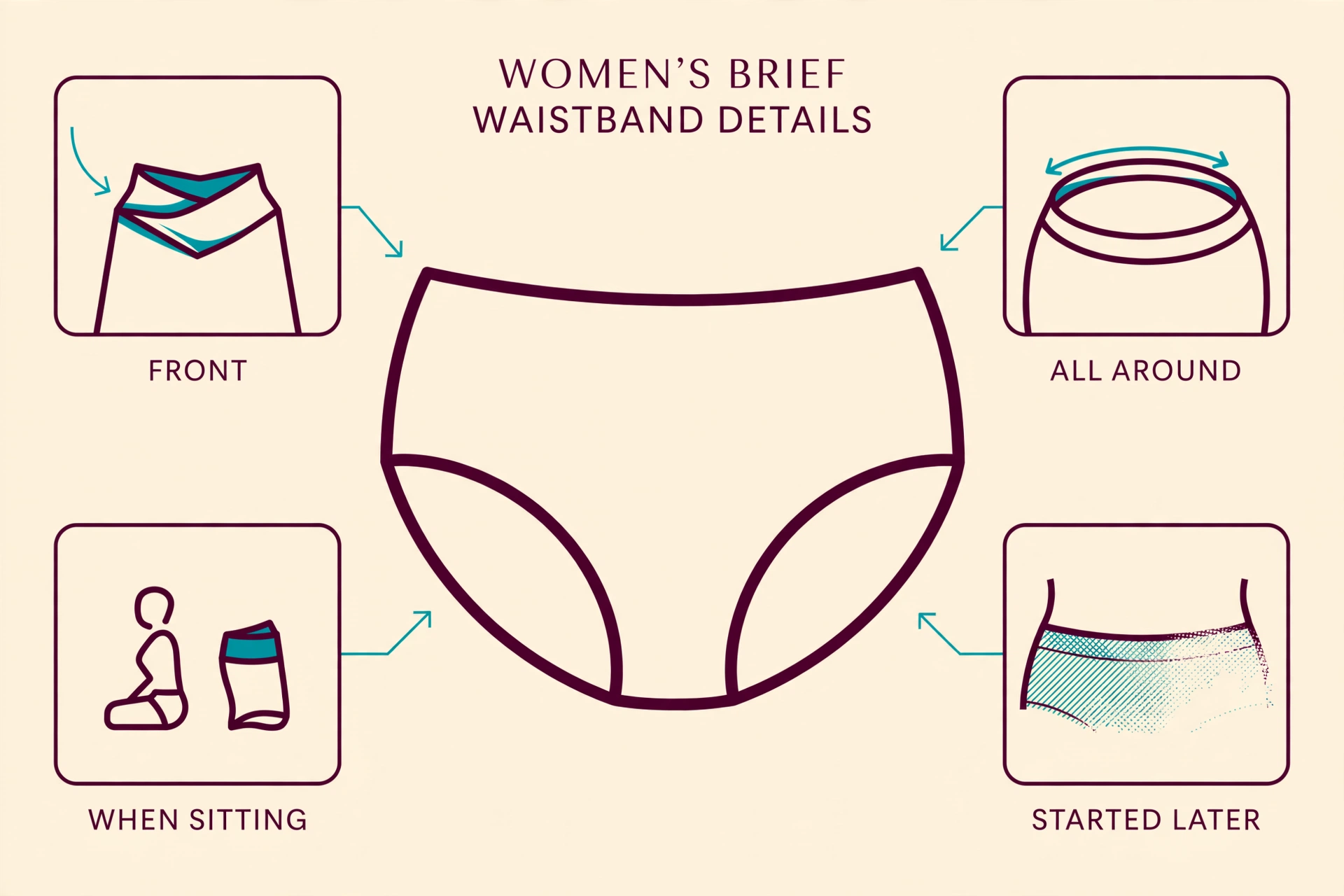
Diagnostic router: match the behavior, then run the test
If it rolls mainly at the front
Front rolling is a location clue, not a diagnosis. HerRoom’s fitting guide treats a waistband that keeps bunching up and rolling over at the front as a sign of the wrong size, and its suggested comparison is to try a smaller size. Treat that as your first test, not a verdict: worn elastic and a fold-prone band construction can also show up at the front.
- Test: After the placement reset, try the same style one size down (and, if accessible, one size up).
- Result → meaning: If the smaller size stays flat and comfortable, size was likely the factor. If every size rolls the same way, size is probably not the driver — move to the construction and wear-state branches.
- Next action: Buy and keep the size that passes the sit test below; if no size passes, change one variable at a time (rise, then construction).
If it rolls around most or all of the waistband
Rolling that happens around the whole band points toward a general band-hold problem — size, rise seating, construction, or elastic condition — rather than one local trigger. It cannot separate those four by itself.
- Test: A fresh pair of the same style, size, and rise, worn under the same conditions.
- Result → meaning: If the fresh pair stays put, the older pair’s condition becomes more likely (see the wear branch). If the fresh pair rolls too, the pattern itself — its size curve, rise, or band construction — is the problem for you.
- Next action: Fresh pair fails → change the pattern (size, then rise, then band construction). Fresh pair holds → that points toward a wear-state case in the older pair (see the wear branch).
If it rolls mainly when you sit or move
Movement is best understood as an amplifier, not a root cause. Research on fitted waistbands finds that the waist–abdomen region deforms differently when seated, which can make an existing fit mismatch more noticeable when you sit than when you stand. Outer clothing can also drag a band out of position — HerRoom notes that pulling trousers or leggings up over a panty can pull the garment out of place.
- Test: The same pair, same outfit, through stand → walk → sit → stand. Then repeat with a different outer layer.
- Result → meaning: If rolling tracks the sitting moment regardless of outfit, movement is exposing a band-hold or seating issue. If it tracks one particular outer garment, friction/drag at the interface is part of the picture.
- Next action: Run the fresh-pair test from the branch above; movement-triggered rolling with a fresh pair that also rolls points back to size, rise, or construction — not to your posture.
If it started only after a period of wear
A pair that behaved when new and started rolling later makes wear state a candidate — and the leading candidate only when the band also looks or feels stretched out compared with a fresher pair. Timing alone does not prove it: the check below is what separates worn elastic from a pair that was never right.
- Test: The fresh-pair comparison, done as the elastic check in the next section.
- Result → meaning: Fresh identical pair holds, older pair rolls → the older pair’s elastic condition is the most plausible explanation. Both roll → go back to size/rise/construction.
- Next action: A pair whose elastic has lost recovery is a replacement case, not an adjustment case (see the wear cause below).
The four evidence-supported causes
Cause 1: Size — and why “too small vs too big” is not a coin flip
The clearest panty-specific fitting guidance ties rolling to the too-large direction. HerRoom states that a waistband bunching and rolling over at the front indicates the wrong size and suggests trying a smaller size; its fit guide adds that panties constantly coming out of place are a sign the elastic has lost its hold or the size is too large. That makes “try the comparison in the other size” the correct move — and makes any blanket claim that rolling always means “size up” unsupportable.
For completeness: manufacturers of compression garments (a differently built category — see the boundary note below) also link rolling to a waist that measures too small. That guidance comes from shapewear, not everyday panties, so for a regular panty treat size direction as a question the adjacent-size comparison answers, rather than an assumption you start with.
Practical rule: compare, don’t guess. The size that stays flat through the stand-walk-sit-stand sequence is the evidence.
Cause 2: Rise and where the band is seated
Rises are engineered to seat the waistband at different heights: HerRoom describes a full brief as designed to sit at the natural waist, just below the navel, while hipsters, bikinis, and most thongs are designed with waistbands that sit lower. A band only behaves as designed when it is actually seated at its designed position — which is why the placement reset comes first in this guide.
- Test: Same size, different rise — for example, the low-rise style that rolls versus a brief designed to sit at your natural waist.
- Result → meaning: If the natural-waist brief stays seated and the low style rolls, rise seating is a factor for you. Report it to yourself exactly that way: as a comparison result, not a body rule.
- Next action: Shop the rise that passes your sit test. If you are unsure where your natural waist is, it is the natural indentation at your side — bending sideways shows the crease. (Our guide to reading a lingerie size chart covers the measuring method in full.)
Cause 3: Waistband construction
Not all waistbands are built to resist folding equally. Sewing-supply and manufacturer documentation classifies certain woven elastics as “non-roll” — elastic woven with sideways ribs specifically to resist rolling and twisting in waistbands — which plain elastic does not offer. How the band is attached is another variable worth comparing: the elastic may be sewn flat, or sit loose inside a fabric casing.
Two construction variables are worth knowing rather than assuming:
- Width alone is not the decider. A wider band does not automatically fold less; construction (ribbed/non-roll elastic; whether the elastic is sewn flat or sits loose in a casing) appears to matter as much or more.
- Silicone grip strips change the interface, not the fold. A silicone grip raises friction against the skin and can make a band less likely to slide. Sliding and folding are different failures, so grip is not a promised cure for rolling.
- Seamless styles are a different hold system. Laser-cut, bonded styles replace a separate elastic band with the fabric’s own stretch, so there is no distinct band to fold — but hold then depends entirely on that fabric’s stretch and recovery.
- Test: Same size and rise, different band construction (e.g., a pair with sewn-flat or non-roll-type elastic vs your current pair).
- Result → meaning: If the different construction stays flat where the old one folded, construction was the variable.
- Next action: When shopping, read the waistband, not just the size label: how is the elastic built and attached?
Cause 4: Wear state — elastic that has lost its recovery
Textile research is consistent on the underlying material behavior: laundering reduces a fabric’s elastic recovery and increases permanent stretch-out, with the largest changes tending to occur in the early washes; repeated stretching in wear progressively reduces elastane recovery as well; and heat and chlorine bleach degrade elastane over time, which is why care guidance for stretch garments advises cool washing and air-drying.
The bridge to your waistband is an inference, and it is labeled as one: when a waistband’s elastic has taken a permanent set, it may no longer pull back evenly — one plausible reason an older pair starts folding or shifting when a newer identical pair does not. The fresh-pair comparison (below) is how you test that inference instead of assuming it.
There is no honest home number for this. No percentage of stretch, wash count, or month threshold tells you a pair is “worn out” — anyone quoting one is inventing precision.
The elastic check (a comparison, not a measurement)
This is the single most useful isolation test in this guide, and its limits matter as much as its method.
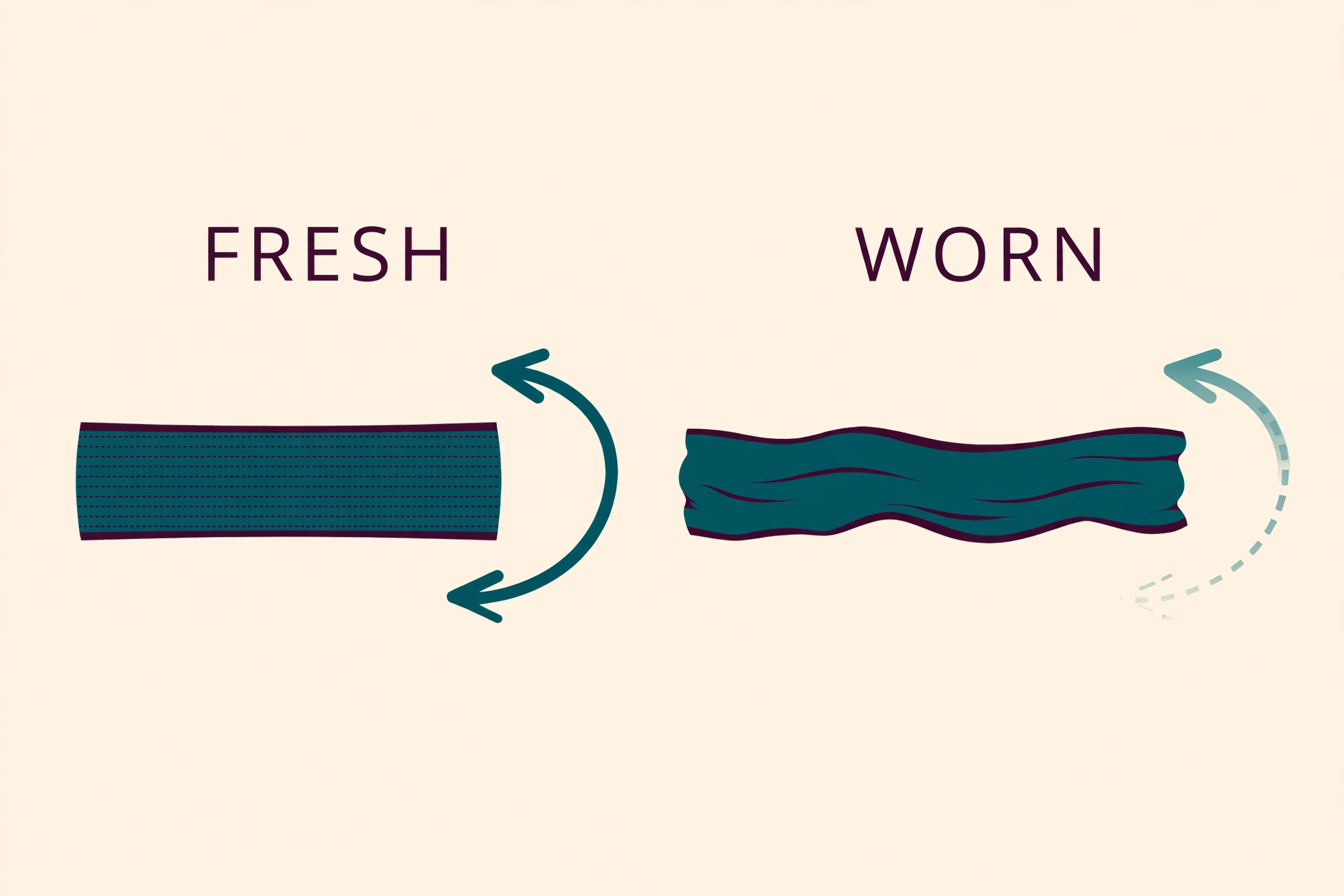
Do this: Take the pair that rolls and a fresh pair of the same style, size, and rise. Stretch each waistband side by side with your hands and let go. Watch what each band does.
Read the result: If the older band stays visibly more stretched-out and pulls back more slowly or weakly than the fresh one, that points toward lost recovery in the older pair — consistent with what textile studies document about washing and repeated stretch. If both bands behave the same, elastic condition is probably not your variable; go back to size, rise, or construction.
Respect the limits: This comparison cannot tell you how much life is left in a band, and there is no home threshold for “worn out.” Laboratory elastic-recovery tests exist, but they use controlled loads and timed recovery on test equipment — adapting them to a hand stretch would produce fake precision, so this guide does not offer a numeric version.
Care notes that the evidence actually supports
Prevention here is narrow, because only a few care claims survived evidence checking:
- Keep elastane away from heat where you can. Heat degrades elastane over time; cool washing and air-drying are the standard protective guidance for stretch garments.
- Expect the biggest recovery changes early. Textile studies find the largest shifts in recovery tend to occur in the first washes, then level off — so a pair’s early behavior is informative, and a pair that only misbehaves much later is telling a different story (wear, not original fit).
- Do not try to “restore” dead elastic. Once recovery is lost, no wash restores it; a stretched-out band is a replacement decision. HerRoom’s guidance is the same: stretched-out waistbands and leg openings are its stated sign that it is time for new panties.
Two boundaries worth stating plainly
This is not the riding-up problem. A panty that migrates up at the back is a coverage and leg-opening geometry issue; fitting guidance treats it under separate causes from a waistband that will not stay flat at the top. If your symptom is rear migration rather than waistband rolling, you have a different fit problem, and the tests above are not designed for it.
This is not shapewear troubleshooting. Shaping briefs are constructed to apply targeted compression — sometimes with zoned panels, boning, or no-slip waistband features — so they are assessed differently from an everyday panty. A similar-looking roll on a compression brief does not carry the same meaning, and this guide’s router is built for everyday panties.
FAQs
Does a rolling waistband mean my panties are too small?
Not on the available evidence. The clearest panty-specific fitting guidance ties front rolling to the wrong size and suggests comparing a smaller size, and notes that a too-large pair may not stay anchored. Compression-garment makers give the opposite-direction advice for shapewear, which is a different garment. The honest answer is to run the adjacent-size comparison and let the sit test decide.
Why does the waistband roll only when I sit down?
Sitting changes how the waist–abdomen region deforms, so an existing mismatch — size, seating, construction, or tired elastic — can show up seated while looking fine standing. The sit-triggered pattern tells you movement is exposing the issue; the fresh-pair and size comparisons tell you which issue it is.
Can I fix a waistband that has lost its stretch?
No. Lost elastic recovery is permanent set, not a setting you can reset. If the fresh-pair comparison shows the older band staying stretched and pulling back weakly, replacement is the fix — that comparison, not a number of washes or months, is the test.
Is a wider waistband the answer?
Not by itself. Width alone does not decide whether a band folds; elastic construction (such as ribbed non-roll elastic), how the band is attached, and its condition matter as much or more. Compare constructions the same way you compare sizes: one variable at a time.
When should I just replace the pair?
When the behavior started after a period of good wear and the fresh-pair comparison shows the older band visibly stretched out and slow to pull back. That combination points toward elastic that has lost recovery — the one cause on this list that adjustment cannot fix.
Bottom line
A rolling waistband is a garment-behavior problem with separable causes, and the slogans (“too small,” “too big,” “just buy wider elastic”) skip the separation step. Watch the behavior, run the one comparison that branch calls for — placement reset, adjacent size, different rise, different construction, or a fresh like-for-like pair — and change a single variable at a time. The test result, not the product promise, tells you whether you had a size problem, a seating problem, a construction problem, or a pair whose elastic is simply done.
Sources
- HerRoom, Panty Fitting Information (front waistband rolling and size guidance; natural-waist measurement).
- HerRoom, Panty Fit & Style Guide (rise seating heights, placement mistakes, replacement signs, rear ride-up as a separate coverage issue).
- SPANX, Shapewear Size & Compression Guide (manufacturer guidance on rolling in compression garments; compression construction for the boundary note).
- WAWAK, Choosing Elastic (non-roll elastic classification; silicone-grip elastic) and Dritz/Prym manufacturer documentation (ribbed non-roll woven elastic).
- Senthilkumar & Anbumani, Journal of Textile and Apparel, Technology and Management (NC State) — laundering effects on elastic recovery and permanent set.
- Penava et al., Materials (2022) — elastic recovery under repeated stretch cycles.
- Zheng et al. (2025) — waist–abdomen deformation in standing vs sitting in fitted garments.
1 thought on “Why Do My Panties Keep Rolling Down? (Waistband Causes & Fixes)”
Comments are closed.