Shopping for a babydoll or a chemise online feels like it should be simple. Two short, sleeveless, pretty garments. Pick the one you like the look of, check your size, done.
Then the listings start contradicting each other. One retailer’s “chemise” has an empire waist and a flared skirt. Another retailer’s “babydoll” falls to the knee with a straight, slip-like cut. A third product is titled “Chemise Nightgown Babydoll” — all three words at once, as if the distinctions don’t matter.
They do matter, because the two garments behave differently on the body: different length, different coverage, different movement, and very different odds of doubling as something you can actually sleep in. The labels, unfortunately, are unreliable guides. This article explains the structural difference, shows you how to read the actual garment in product photos, and gives you a decision framework based on what you want the piece to do — not on what the title claims it is.
Why These Two Get Confused
The confusion isn’t your fault. It’s built into how these garments are sold.
Retailers routinely use “babydoll,” “chemise,” and “nightgown” interchangeably — sometimes on the very same product. Large marketplaces carry listings titled things like “Lace Chemise Nightgown Babydoll,” stacking all three terms into one title so the product surfaces no matter which word a shopper searches. Some retailers even merge the two into a single category page, filing babydolls and chemises together as if they were one garment type.
There are reasons this happens. The two styles genuinely share a silhouette family: sleeveless, strap-shouldered, loose below the bust, usually marketed as both lingerie and nightwear. Many chemises are, functionally, nightgowns — the words describe overlapping territory. And because neither term is regulated or standardized anywhere in the industry, no authority exists to tell a retailer it’s using the wrong one.
So treat the product title as a clue, not a verdict. The rest of this article teaches you to identify what you’re actually looking at — because garment construction is more reliable than the label.
The Structural Difference, in One Paragraph
A babydoll is built around a transition: a defined upper section (often with a visible seam under the bust) from which the fabric releases or flares into a short, loose skirt, with the hem typically landing high on the thigh. A chemise is built like a slip: a more continuous vertical line from shoulder to hem, without that dramatic release point, usually cut longer and closer to the body through the hips. Everything else — length, coverage, sleep practicality, support — flows from that one construction difference.
“Typically” is doing real work in that paragraph. Individual designs vary widely on both sides, and mislabeled listings blur the line further. But when you understand the two underlying architectures, you can classify almost any listing in seconds.
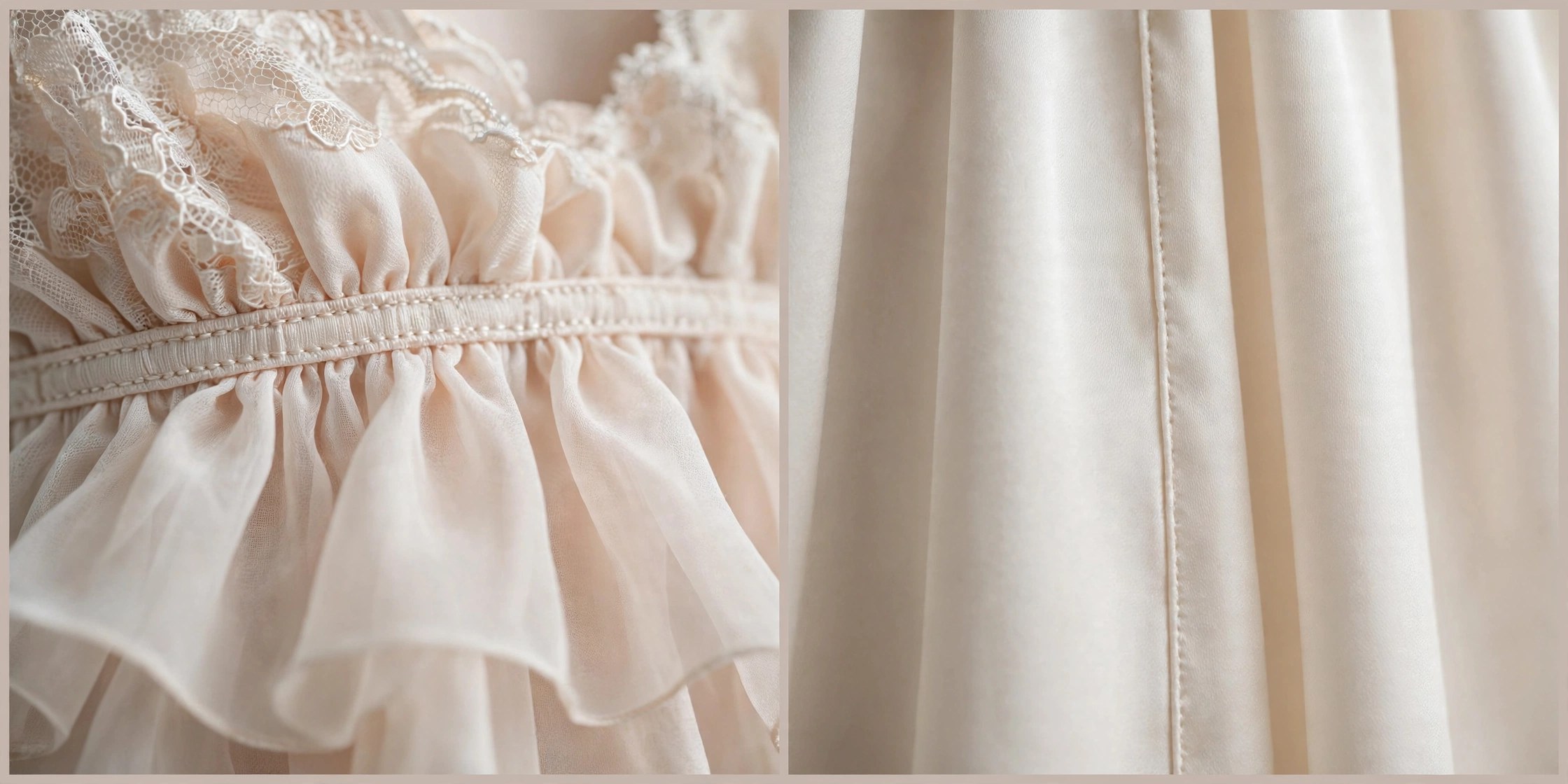
Babydoll: The Short Version
Since this site already covers the babydoll in depth, here’s the compressed version — just enough to make the comparison work.
A babydoll’s defining feature is its two-part architecture: a fitted or semi-fitted bodice that ends at or just below the bust (usually marked by an empire seam), and a skirt that flares away from the body from that point down. The hem generally lands at the upper to mid-thigh — short enough that many babydolls are sold with a matching separate panty. Bust construction varies enormously, from soft unstructured lace to underwired, molded, or seamed cups; “bust emphasis” and “bust support” are not the same thing, and a babydoll can deliver the first with almost none of the second.
For the full breakdown — empire-seam construction, the range of bust support, built-in versus separate bottoms, and how to diagnose babydoll fit failures — see our dedicated guide: Teddy vs Babydoll: What’s the Difference (and Which Should You Choose?)
The one babydoll fact that matters most for this comparison: the skirt leaves the body. From the empire seam down, the fabric is designed to stand away from the torso. That single property drives most of the practical differences below.
Chemise: Slip-Like Construction, Explained
This is where the genuinely new information lives, because the chemise is the less-understood half of the pair.
A continuous line, not a release point
A chemise is essentially a short slip dress. Where a babydoll has a visible transition — bodice, then seam, then flared skirt — a chemise runs in a more continuous vertical line from the shoulder straps to the hem. There’s no empire seam forcing the fabric outward. The garment may skim, float slightly, or follow the body’s line, but it doesn’t have an engineered flare point.
This sounds subtle. In practice it’s the first thing to look for in a product photo: ask where the garment first widens. If the widening starts abruptly just under the bust, you’re looking at babydoll architecture. If the garment falls in a relatively straight column — widening gradually if at all — you’re looking at chemise architecture. Many “which is it?” listing mysteries resolve right there.
Length and what it covers
Chemises typically run longer than babydolls: commonly mid-thigh to knee-length, with some styles falling shorter or longer. That extra length is doing quiet work. It means the hem usually clears the fullest part of the hip and sits lower on the thigh, which changes both coverage and how the garment behaves when you move, sit, or sleep.
Note the word “typically.” Short chemises exist, and long babydoll-inspired pieces exist. Length alone doesn’t settle the question — it’s one signal among several, and the checklist later in this article combines them.
The bust: usually unstructured, but check
Most chemises have minimal bust engineering: no underwire, no molded cups, often just a shaped neckline (V, scoop, or cowl) with the fabric’s own drape doing the work. Adjustable straps are common and genuinely useful, since strap length effectively sets where the neckline sits.
“Usually” matters here too. Some chemises include light bust support — a shelf-style elastic underbust band, soft seamed cups, or light padding. And some babydolls are equally unstructured. So don’t assume: inspect the listing for underwire, cup seams, underbust elastic, and strap adjustability, the same way you would for any lingerie top. A chemise that looks delicate in the thumbnail may still have hardware you’d feel at 3 a.m. — which brings us to the sleep question.
Fabrics and why they change the drape
Chemises are most commonly cut from fabrics chosen for drape: satin, silk or silk-like charmeuse, and soft microfiber. These fabrics fall in smooth vertical folds, which is exactly what creates the slip-like line. Babydolls lean more toward chiffon, sheer mesh, and lace — fabrics chosen for float and transparency rather than drape.
Fabric isn’t just aesthetic here; it determines behavior. A satin chemise slides against bedding and against itself. A chiffon babydoll skirt billows and rides. When you’re deciding between the two for anything beyond standing still in front of a mirror, fabric is one of the most predictive details on the listing — check the stated fiber composition, not just the marketing adjectives.
The chemise’s double life
Historically, a chemise was the simple garment worn next to the skin — the ancestor of both the slip and the nightgown. That heritage survives in the modern version: many chemises genuinely function as nightgowns, and plenty of shoppers buy them specifically to sleep in. Some are even cut long enough to work as a slip under dresses, though that’s a secondary use worth verifying (length, smoothness, and neckline all matter for layering).
This double life is the chemise’s real strategic advantage in a buying decision — and it’s the reason the sleep question deserves its own section rather than a yes/no answer.
Length and Coverage: What Changes in Practice
Abstract descriptions only go so far. Here’s how the construction difference plays out on the body.
Hem versus hip and thigh. A babydoll’s hem typically lands high — upper to mid-thigh — because the garment is short by design. A chemise’s hem typically lands lower — mid-thigh to knee — because the garment is longer by design. The practical consequence: a chemise covers more of the thigh at rest, and the difference grows when you move.
Flare versus straight drape. This is the coverage detail most shoppers miss. A babydoll’s flared skirt stands away from the body, which means coverage depends on where the fabric is, not where the body is — sit down, bend, or catch a breeze, and the skirt moves independently. A chemise’s straighter drape stays nearer the body, so its coverage is more predictable in motion. Neither is “better”; they simply behave differently, and the right choice depends on what you’ll be doing in the garment.
Why listing-model height can mislead. Product photos are usually shot on models of a specific height, and hem placement is relative. A chemise photographed on a tall model may look thigh-skimming when it would fall to the knee on a shorter shopper — and a babydoll on a petite model may look longer than it will on you. If the listing gives the model’s height and the garment’s length, use both; if it gives neither, treat the photo’s proportions as approximate, not exact. This is one of the highest-value details a listing can provide, and its absence is itself information.
Can You Sleep in It? Answering Carefully
This is the question that brings many shoppers to this comparison, and it deserves a careful answer — because the common shorthand (“chemises are for sleeping, babydolls aren’t”) is an oversimplification that will disappoint someone.
The label alone doesn’t determine sleep suitability. Construction does. A chemise with scratchy lace trim, a hook-and-eye closure at the back, and stiff boning at the sides will sleep worse than a soft, hardware-free babydoll. Evaluate the actual garment against these variables:
- Hardware: underwire, hook-and-eye closures, metal adjusters, clasps, rings — anything rigid you can feel when you roll onto your side.
- Boning or side stays: some structured styles in both categories include them; they’re support features, not sleep features.
- Strap adjusters: small sliders are usually fine; large or metal ones can press.
- Lace and trim texture: decorative lace often has a rough side. Check whether the listing mentions a soft lining, or whether reviews mention scratchiness.
- Fabric softness and stretch: satin, silk-like fabrics, and soft microfiber tend to sleep best; stiff mesh and coarse lace tend to sleep worst.
- Hem coverage: longer hems bunch less and ride up less during the night.
- Separate bottoms: a babydoll sold with a separate panty means two garments to manage while sleeping instead of one.
- Decorative elements: bows, jewels, appliqués, and cutouts placed at pressure points (back, sides) are worth noticing.
As a tendency — not a rule — chemises clear more of these hurdles more often: softer drapey fabrics, fewer closures, longer hems, no separate bottom. That’s why the chemise has its reputation as the sleep-friendly option, and the reputation is roughly earned. But “roughly” is the key word. A specific babydoll in soft modal with no hardware can out-sleep a specific chemise trimmed in stiff lace. Inspect the garment, not the category.
Bust Emphasis Is Not Bust Support
Both categories play games with the bust, in opposite directions — and shoppers routinely confuse emphasis with support.
A babydoll often emphasizes the bust: the empire seam sits directly beneath it, the bodice frames it, sheer fabrics reveal it. None of that is support. Actual support comes from underwire, molded or seamed cups, a firm underbust elastic, or structured side panels. Plenty of babydolls have these; plenty don’t. The sheerest, most dramatic-looking babydoll in a listing may offer the least actual support of anything on the page.
A chemise usually de-emphasizes bust engineering: the drape skims rather than frames. But “usually unstructured” is not “always unsupportive” — a chemise with a shelf elastic underbust or soft cups can offer light, comfortable support, and its smooth drape can look more settled than a flimsy unstructured babydoll.
The practical takeaway: when bust behavior matters to you, inspect for the specific features — underwire, molded cups, soft cups, cup seams, underbust elastic, adjustable straps, shelf construction where present — rather than inferring support from how dramatic the bust area looks in the photo. And if a listing doesn’t show or describe the bust construction at all, that’s a gap in the listing, not a guarantee of anything.
How to Tell Them Apart in Product Listings
Use this checklist on the listing photos and description. It’s adapted specifically for the babydoll-vs-chemise decision — for the deeper babydoll-only version, see our teddy vs babydoll guide.
- Where does the garment first widen? Abruptly just under the bust (babydoll architecture) or gradually along a straight fall (chemise architecture)? This is the single most reliable signal.
- Is there a visible empire seam? A horizontal seam under the bust with fabric releasing below it points to babydoll. Its absence points to chemise.
- Does the fabric fall straight or flare away from the body? Look at the product photos from the side angle if one is provided — flare reads clearly in profile.
- Where does the hem land relative to the hip and thigh? Upper thigh suggests babydoll; mid-thigh to knee suggests chemise. Cross-check against model height if given.
- Is there a separate panty? Babydolls are frequently sold with a matching separate bottom; chemises essentially never are. A “2-piece set” label is a strong babydoll signal.
- What bust construction is visible? Underwire, molded cups, or heavy seaming can appear in either, but elaborate bust engineering combined with a flared skirt is classic babydoll territory.
- Are there sleep-unfriendly details? Scan for hardware, boning, stiff trim, and back closures regardless of which label the title uses.
- Does the listing give garment length or model height? These two numbers, when present, let you estimate where the hem will actually land on you. Their absence means you’re guessing from styling.
If most signals point one way and the title says the other, trust the signals. Remember the marketplace listings titled “Chemise Nightgown Babydoll”: the title was written for search engines. The garment was cut for a body.
Which Should You Choose?
Frame this around what you want the garment to do. These are directional, not rigid — individual designs cross every line drawn here.
Lean toward a chemise if you prioritize:
- More continuous coverage from bust to hem
- Realistic sleep or lounge crossover (subject to the construction checks above)
- A slip-like drape rather than a flared skirt
- A smoother line under a robe or as a layering piece
- Simplicity: one garment, no separate bottom to coordinate
Lean toward a babydoll if you prioritize:
- Shorter coverage and more leg exposure
- A pronounced transition between bust and skirt — the empire-line silhouette itself
- Looser fabric release through the hips (nothing clinging at the hip line)
- Maximum bust emphasis in the design
- A lingerie-specific silhouette rather than something that reads as a slip or nightgown
One more consideration that cuts across both: if you’re actually torn between these and a one-piece style — if part of you is wondering whether you want a teddy or bodysuit instead — that’s a different decision with different construction questions, and it’s covered in Bodysuit vs Teddy: What’s the Difference (and Does the Label Matter?).
Frequently Asked Questions
Is a chemise the same as a nightgown?
Not exactly, but they overlap heavily. “Nightgown” describes a garment’s use (something you wear to sleep), while “chemise” describes its cut (a slip-like, straight-falling dress). Many chemises are bought and used as nightgowns, which is why retailers often use the words interchangeably. A useful way to think about it: all chemises can be nightgowns, but not all nightgowns are chemises.
Can you sleep in a chemise?
Often yes — chemises tend to have the right construction for it: soft drapey fabrics, minimal hardware, longer hems, no separate bottom. But check the specific garment for underwire, back closures, stiff lace trim, and scratchy details before assuming. The label doesn’t guarantee sleep comfort; the construction does.
Can you sleep in a babydoll?
Sometimes, but the odds are lower. Babydolls more often include the sleep-unfriendly features — structured or underwired busts, decorative hardware, sheer fabrics that ride, and a separate panty. A soft, simple, hardware-free babydoll can sleep fine; evaluate it against the same construction checklist.
How can I tell which one a listing is actually selling?
Ignore the title and run the signals: where the garment first widens, whether there’s an empire seam, whether the fabric flares or falls straight, where the hem lands, and whether a separate panty is included. Listings that stack all three terms into one title (“Chemise Nightgown Babydoll”) are the ones where this method pays off most.
Do I need to wear a bra under a chemise?
Usually no — most chemises are designed to be worn without one, and their smooth drape generally looks best that way. If you want light support, look for chemises with a shelf-style underbust elastic or soft cups rather than adding a bra underneath, which tends to show lines through the drape.
The Bottom Line
Babydolls and chemises look like variations on one idea, but they’re built on two different architectures: the babydoll’s empire-seam release versus the chemise’s continuous slip-like line. That single structural difference determines the length, the coverage, how the fabric moves, and how realistic the sleepover crossover is.
Retailers will keep mixing up the names — the “Chemise Nightgown Babydoll” listing isn’t going away. But once you read the garment instead of the title — where it widens, where the hem lands, what’s actually engineered into the bust — the confusion mostly evaporates. Choose by construction, and you’ll get the garment you actually wanted.