By MA
If your underwear keeps creeping up in the back while the waistband itself stays put, you are dealing with rear migration — and the frustrating part is that not every pair does it for the same reason. A pair can ride up because of how its fabric sits under the rear — a pattern fitter guidance associates with certain cuts — because its leg edges have lost their hold, or because the size is off in one direction or the other. Treating all three as one problem (“just buy a different brand”) rarely fixes any of them.
This guide is a diagnostic, not a cause list. You will start by confirming this is the right problem, then run a few controlled comparisons on pairs you already own — when it started, whether a fresher pair behaves the same way, whether another style in your drawer stays put — and follow only the branch your observations point to. No single cause is claimed, and where the evidence is fitting guidance rather than proof, it is labeled that way.
Quick answer
Rear ride-up comes from different fit and wear patterns, and ride-up alone does not tell you which one is yours. The useful question is not “what makes panties ride up in general?” but “what changes when I compare?” — the timing (from the first wear, or only after months?), the garment’s condition (does a fresher pair of the same style behave differently?), the style (does another cut in the same labeled size stay put?), and adjacent sizing (which failure pattern changes when you move one size?). Work through Step 0 first, then follow the branch your answers open. One pair of tests will not prove a cause — but it will tell you which comparison is worth making next.
Step 0: Make sure this is the right problem
Before any test, confirm you are looking at rear migration: the fabric at the back migrates upward while the waistband stays broadly in place. Standing, walking, sitting and standing again — check where the problem actually is. If the rear fabric has climbed but the band is still sitting where you put it, continue here.
If what you are seeing is the waistband itself rolling, folding, or sliding down, that is a different mechanical problem with different causes, and it deserves its own diagnosis: see Why Do My Panties Keep Rolling Down?. The two are easy to confuse at a glance, but a waistband that will not stay seated also makes the rear panel’s position impossible to judge — so band movement is diagnosed first, there. This article covers only the case where the band stays and the back climbs anyway.
One quick reset belongs here, before you conclude anything. When you put the pair on, seat the back of each leg opening so it curves under the cheek rather than resting across it — this is how specialist fitter guidance (HerRoom’s panty fitting guidance) describes placing the leg opening. Then do one ordinary cycle: stand, walk a few steps, sit, stand again. If the migration you were seeing disappears after the reset, that points to placement — how the pair went on rather than a size or style fault — and you are done. If the back panel climbs again within that same cycle, placement is ruled out and you have a real pattern to diagnose.
When does it start?
Timing is the cheapest observation you own, and it decides which comparison is worth running next. It does not name a cause by itself — think of it as routing, not evidence. Four patterns are worth separating:
- It has done this since the first wear. The pair arrived behaving this way and never settled. That observation rules wear out for this pair: nothing has had time to degrade. Your next comparisons are style and size.
- It developed over months of wearing and washing. The pair used to stay where you put it, and the migration crept in later. That points toward the garment’s condition having changed — the wear branch below is your first comparison.
- It happens only after moving around or sitting and standing. Note it, but do not branch on it yet. Movement tends to reveal a marginal fit or a tired leg edge rather than create the problem on its own, and a pair that migrates when you sit funnels to the same coverage and condition questions as one that migrates when you walk. Keep it as context for whatever branch you end up in.
- It happens in both old and new pairs. If a freshly bought pair migrates the same way as your worn ones, wear drops down the list and style or size move up. You can skip ahead to the style screen.
Two separations matter most: first-wear versus developed-over-time (which decides whether wear is even a candidate), and old-versus-new behavior (which you will test directly in the next section if timing suggests it).
Old pair vs fresh pair: the wear-state comparison
If the migration developed gradually in a pair that used to behave, the most useful single test is to compare that worn pair against a newer equivalent — ideally the same style, as fresh as you have — and see whether the behavior changes with the garment’s condition. This is a comparison, not a measurement: it tells you whether wear state and behavior move together in your drawer, not how much stretch any elastic has lost. Batches of the same style can vary slightly, so treat a small difference as inconclusive rather than a verdict.
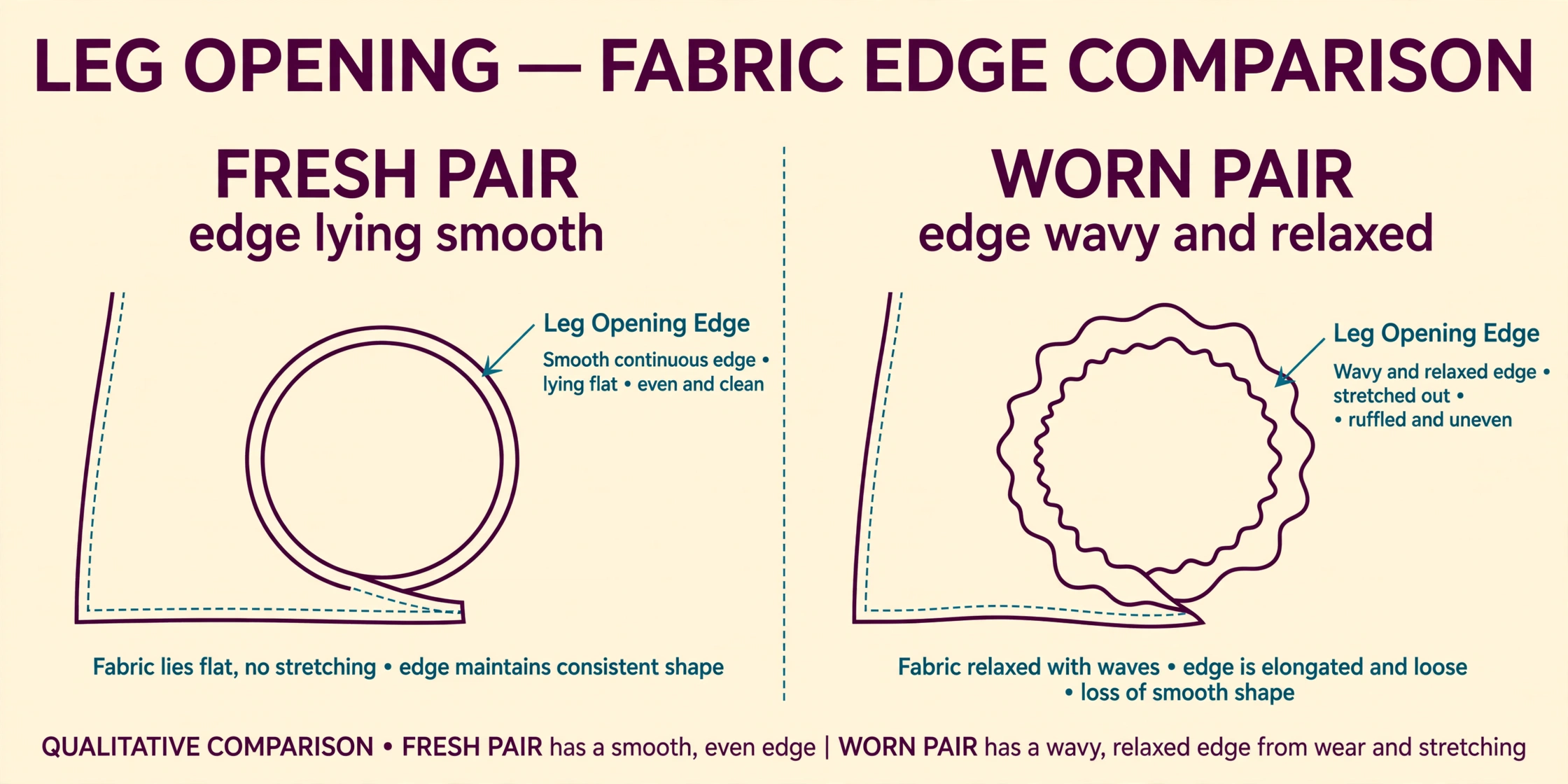
Before you even run it, the worn pair itself offers readable signs. Specialist fitter guidance describes tired leg elastic in observable terms: leg openings that sit stretched out or no longer follow a smooth line, a leg edge that has gone wavy or ruffled when the garment is relaxed, fabric wear or fraying, and backs that have begun to migrate continually rather than occasionally. None of these is a number, and none is proof on its own — but a pair showing several of these together is a strong wear-state candidate before you test anything.
The mechanism underneath is real but only needs stating plainly: washing gradually reduces elastic’s ability to recover its original length, so an edge that once held its line can end up merely resting against the skin. Treat that as background, not a diagnosis — what matters is the comparison. If the fresh pair settles and stays where the old one climbs, the likeliest difference between them is condition, and the honest correction is that the old pair’s useful fit life has ended, regardless of how it looks hanging in the drawer. If the fresh pair migrates in the same way, condition is not your explanation for this style — move to the style screen instead of buying replacements.
The style and coverage screen
Suppose the migration is there from the first wear, or a fresh pair does it too. The next comparison uses what is already in your drawer: does another style in the same labeled size stay put? One word of discipline first — “same size” here means the same labeled size, and size labels are not standardized across brands. The cleanest version of this screen is two cuts from the same brand: one that migrates, one that stays. If you do not have that pair, the question still works in its softer form: do most pairs in your usual size stay put, and this cut is the exception — or does everything ride up?
Specialist fitter guidance is unusually consistent on what the exception tends to look like, and it is worth stating with its attribution intact: fitter guidance describes cuts that leave less fabric under and behind the rear — high-cut legs and minimal backs — as the ones prone to creeping inward, while fuller cuts whose leg openings sit under the cheeks hold more fabric in place. That is experienced guidance, not a measured law, and it comes with no guarantee in either direction. The practical translation is about where the leg edge sits on the pair in your hand, not about style names: a style name describes a silhouette family, not a fixed amount of rear coverage, and within a single name the coverage shifts with construction details such as where the side seams sit. Two pairs both labeled “bikini” can put the leg edge in visibly different places.
So check the pair physically. Lay it flat and look at the back: does the leg edge curve downward so it would pass under the cheek, or does it run high and across where the cheek will be? On the body, after the Step 0 placement reset, note whether the garment begins displaced — edges already sitting across the cheek — or starts seated and migrates later. Starting displaced weighs more toward the cut itself; starting seated and drifting later weighs more toward hold and condition. If another cut in the same labeled size stays put while this one climbs from the first wear, construction is the branch you have evidence for — and the correction is a different leg-line placement, chosen by the edge position you just learned to read, not a new random style.
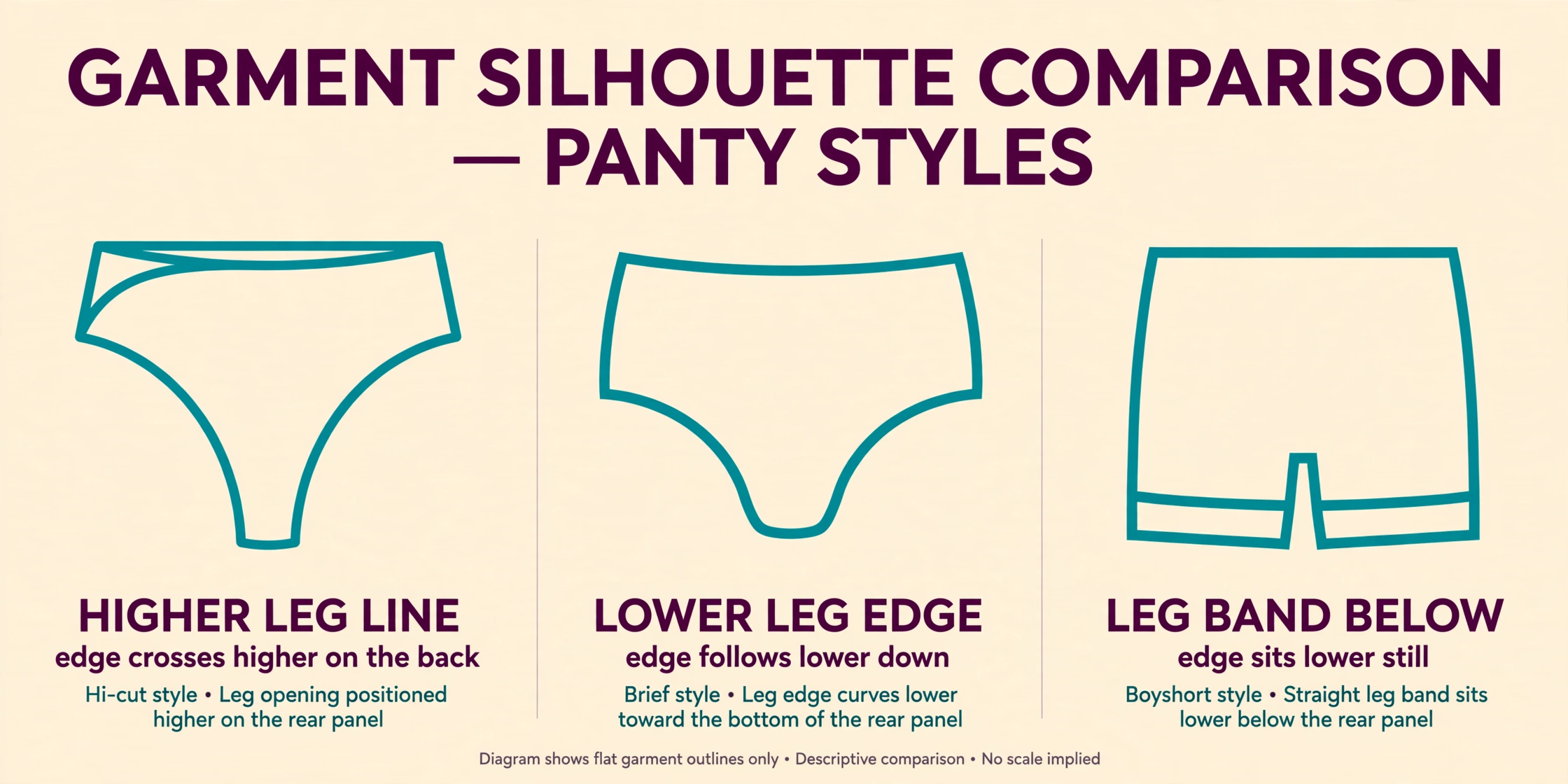
A word on boyshorts, because they are often sold as the answer: a longer leg down the thigh does not by itself anchor the rear panel, and boyshort rears are reported to ride up much like other styles. Length at the thigh is not evidence of stability at the back — judge any boyshort by the same leg-edge placement check above, not by its reputation.
The adjacent-size comparison (handle with care)
If every style in your usual labeled size tends to migrate — including fresh pairs correctly placed — size becomes a candidate. This is the weakest branch of this guide, and it stays cautious for a reason: moving one size changes several things at once. Rise, leg opening, and coverage all shift together in a single size step, so a comparison between two sizes cannot isolate one variable. Use it as a comparison framework, never as proof — and note that the migration alone cannot tell you which direction to try, whatever any shopping guide claims.
What can guide you is the pair’s resting state, not its drift. Fitting guidance documents two different failure signatures, and they point opposite ways:
- Too-small candidate signs: at rest, the rear panel cannot sit covered and smooth — fabric already stretched thin over the rear, leg edges pressing or cutting in. The read is that there is not enough fabric to stay where it was placed.
- Too-large or worn candidate signs: at rest, the pair sits loose — leg edges gaping or wavy, fabric visibly spare rather than held. The read is that the leg opening is not holding its line, leaving fabric free to migrate.
If you do compare an adjacent size in the same cut, read which failure pattern changes: does the stretched-thin look disappear? Does the loose, gaping look disappear? That change is the information. If one direction removes the resting-state problem sign and the migration eases with it, you have a size candidate worth staying with. If neither direction changes the migration, size was not your branch — construction was. If you want to make the comparison well, it helps to read that brand’s size chart before you compare, because the chart shows what the next size actually adds — and labels differ enough between brands that the same letter can describe a different garment.
Do not let any of this harden into a rule. “Ride-up means size up” and “ride-up means size down” are both claims the evidence does not support; the resting signs, plus one comparison, are all that can point the way.
Amplifiers and context
Two contextual factors survived scrutiny, and both are deliberately kept small.
Movement reveals; it does not name the cause. A pair that only migrates when you walk, climb, or sit and stand is telling you its margin is thin — the leg edge or the coverage is near the edge of working. That is useful information about severity, but movement on its own does not select a fix, so treat it as a note inside whichever branch you are in rather than an explanation.
Fabric is a comparison variable, nothing more. You will read confident claims that certain fabrics grip and others glide. Honestly appraised, no wear study tests fiber against rear migration, and laboratory friction results for fabrics conflict even on basics — cotton does not hold a steady “high-grip” verdict across lab methods. If two pairs in your drawer are the same cut and size but different fabrics and only one migrates, that single comparison is worth noticing and is a legitimate reason to prefer one fabric next time you buy that cut. It is not a diagnosis, and fiber rankings (“this blend stays, that blend slides”) are not supported anywhere we could verify.
The correction router
Corrections belong to branches, not to the symptom. Keep yours matched to the evidence you actually collected:
- Behavior unique to an older pair (fresh equivalent stays put; worn-pair signs present): condition is the finding. Retire the worn pair from regular rotation — no adjustment to a fresher garment is implied, and no purchase is yet required beyond replacing what wore out.
- Behavior tied to one cut (another same-labeled-size style stays put; leg edge sits high and across): construction is the finding. Next time, choose by leg-edge placement — an edge that passes under the cheek — and re-run the placement reset before judging the new pair.
- Behavior that changes with an adjacent-size comparison (one resting-state sign disappears along one size direction): size is the candidate. Stay with the direction that removed the sign, and expect the improvement to be partial rather than absolute.
- Behavior unchanged across all of it → read the next section before buying anything else.
In each branch, the correction is only as strong as the comparison behind it. If you changed two things at once — new style and new size — you will not know which one helped, and the next failure will teach you nothing. One variable at a time is slower and is the only version that leaves you with knowledge.
When to stop chasing fit variables
There is a point where further testing stops yielding information: you have placed the pair correctly, compared a fresh equivalent, screened another cut by leg-edge placement, and tried the adjacent size in the direction your resting signs suggested — and the back still climbs. At that point, the useful conclusion is not that some sixth hidden variable remains undiscovered. It is that this style — and possibly this construction family — is not compatible with how you wear your days, and no micro-adjustment inside the same design is likely to change the result.
Stopping there is a result, not a failure. It closes the question without inventing an anatomical explanation for it (garment behavior is the subject; your body is not the problem to be solved), and it redirects the next purchase toward a genuinely different construction rather than a third retry of the same one. If truly every construction migrates the same way in fresh, correctly placed pairs, that uniform pattern is worth noting as information about your preferences in coverage and hold — and still not a defect to diagnose.
FAQ
Does riding up mean my underwear is the wrong size?
Not by itself. Too-small and too-large both appear in fitting guidance as possible contributors, which is exactly why migration alone cannot name the direction. The resting signs — fabric stretched thin and edges cutting in, versus a loose pair with gaping or wavy leg edges — are what suggest which size comparison, if any, is worth running.
Why did my underwear only start riding up after months?
A behavior that develops over time in a pair that used to stay points to the garment’s condition having changed. Elastic gradually loses some of its recovery with repeated washing, and a leg edge that no longer holds its line can let the back panel drift. The way to check is the fresh-pair comparison: if a newer equivalent of the same style stays put, condition is the likeliest difference between them.
Will boyshorts fix it?
Not reliably. A longer leg at the thigh does not by itself anchor the rear panel, and boyshort backs can ride up like other styles. Judge a boyshort the same way as anything else — by where its leg edge actually sits relative to the cheek — rather than assuming the style name is a fix.
Can comparing against a fresh pair of the same style actually tell me anything?
Yes — as a comparison, not a measurement. If the fresh pair stays where the worn one migrates, behavior and condition changed together, which makes wear the leading candidate for that pair. It cannot tell you how worn the elastic is, and small differences between production batches mean a near-tie should be read as inconclusive.
So what is the first thing to try?
The Step 0 placement reset: seat the back of each leg opening under the cheek and run one stand, walk, sit, stand cycle. It costs nothing, it is supported by fitter guidance, and if the migration vanishes it was placement. Only if it returns do the wear, style, and size comparisons earn their turn.
Sources
- HerRoom, panty fitting and style guidance (specialist fitter, Tomima Edmark) — descriptions of cuts prone to creeping inward, leg-opening placement under the cheeks, observable signs of worn elastic (“always coming out of place,” stretched-out legs, fraying), and the too-small “not covered” read. Specialist guidance; used at attributed-guidance strength, not as universal rules.
- Textile and elastic recovery literature (peer-reviewed, including an MDPI review of washing effects on elastic strain recovery) — cited qualitatively only: washing reduces elastic recovery over time. Sample materials in that research were not panty elastics, and no figures from it are used here.
- Incumbent guidance landscape (NeceSera, Bliss Tulle, Wama, ThirdLove, Fallsweet) — consulted for the range of published claims; their numerical thresholds, replacement timelines, and fabric rankings did not meet the evidence bar and were not adopted.