By MA
If one cup fits and the other doesn’t, the bra isn’t broken and neither are you. Standard bras are cut as two matching cups, and two sides of a body rarely match exactly — so a shared cup volume that is right for one side can be wrong for the other. That mismatch shows up as gaping on one side, spilling on the other, or both at once.
This guide works the problem in fitter order: put on one real bra, compare the two cups side by side, read the pattern, then make the smallest adjustment that fixes it. There are no per-side cup sizes here, because there is no honest way to produce them — more on that below. What there is, instead, is a comparison method that works in the bra you already have on.
This guide covers bra fit only. If one side changes in a way that is new or not normal for you, get it checked by a clinician.
Quick answer
When the two sides fit differently in the same bra:
- Start with the size that contains your larger side — contained, with no spilling or compression. Fitters and manufacturers converge on this baseline.
- Then compare both cups in that bra. Which side gaps, which side spills, whether both happen at once, or whether the cups fill evenly but sit differently — each pattern points to a different fix.
- Adjust from the smallest change upward: a slight strap adjustment on the smaller side, a cup construction with more give (or more shape-holding, depending on the pattern), a single insert on the smaller side, or a bra built with two different cup sizes.
- A professional fitting is an option at any point, not a last resort.
Why you can’t tape-measure your way to two cup sizes
It’s natural to want a number for each side. But cup sizing doesn’t work that way: a cup letter is derived from a full-bust circumference compared against the underbust — one measurement wrapped around both sides together. No fitter, manufacturer, or fitting standard we could find validates turning two half-measurements into two independent cup sizes, and half-bust doubling methods trace back to post-surgical fitting, a different context with different goals.
One maker, Evenly, does publish a tape method for uneven breasts: measure from below the armpit of the larger side to the centre of the chest, double it, and add a back measurement. Notice what that produces — a single suggested size, built as if both sides matched the larger one. Evenly frames the result as a starting point to confirm by trying bras on, and chooses insert thickness by assessing the empty space in a fitted, non-stretch bra rather than by tape. Even the brand that sells the method uses it to estimate one starting size, not to size each side.
So the per-side work that actually tells you something happens in a worn bra, not with a tape:
- Which side drives the size — in practice, the larger one.
- How the smaller side behaves in a specific style — where it gaps, how much space is left, and whether a different construction absorbs it.
That assessment is bra-specific. Cup volume differs between brands and constructions, so what you learn in one style transfers to another as a pattern, not as a number.
The candidate-bra comparison protocol
Pick one bra to assess in — ideally a style you own or are trying — in the size that contains your larger side. If you don’t have a reliable starting size yet, how to read a lingerie size chart walks through band and cup sizing first.
- Fasten the band level and snug, then settle each breast fully into its cup — lift the tissue in and let it sit where the cup wants it.
- Check the larger side first. Contained — no overflow at the top or edge, no compression, cup edge lying against the tissue rather than cutting in? If not, the size or style isn’t your baseline yet (see Pattern 2).
- Check the smaller side. Where is the space — gaping top edge, empty lower cup, puckered fabric? Location hints at whether it’s volume, shape, or a cup holding a shape your smaller side doesn’t fill.
- Check the straps. Does one sit higher, slide, or carry visibly more tension?
- Change one thing at a time — size, then construction, then insert — so you know which change worked.
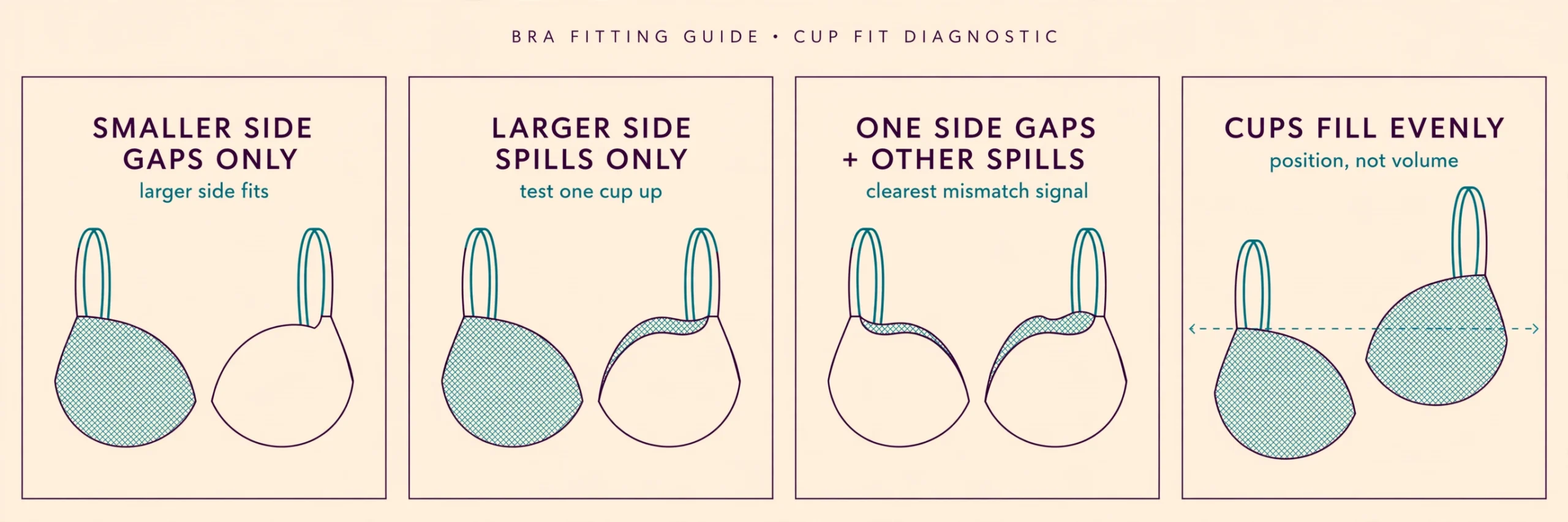
What you see across those checks will match one of four patterns. They describe how the difference presents in a candidate bra — observations about fit, not measurements of your body.
The four patterns: read both cups together
Pattern 1: The smaller side gaps; the larger side fits
Entry condition: your larger side is properly contained — band level, no spill, no compression. Only then is the smaller-side gap meaningful.
A gap isolated to the smaller cup suggests a volume or shape mismatch on that side — or a cup that holds its own shape and can’t settle onto less tissue. Comparison test: the same style with a stretch-fabric cup, or one insert on the smaller side only. If the gap closes with no new problem on the larger side, the mismatch and its fix are confirmed.
Exit: if the gaping appears on both sides, in style after style, that isn’t a side-to-side problem at all — it’s general cup gaping, which we cover in full in why do my bra cups gape at the top.
Pattern 2: The larger side spills; the smaller side fits
On its own, this pattern proves nothing about asymmetry — most spilling is simply a too-small cup.
Comparison test: try the same bra one cup size up, fitted to the larger side.
- The larger side is now contained and a new, isolated gap appears on the smaller side → the mismatch is confirmed. Stay here; the steps below are for you.
- The spilling persists, or both sides spill → general overflow, not a side-to-side issue. Why do my breasts spill out of my bra diagnoses that properly.
The size-up is a bounded test, not a fix: it tells you whether this is one shared size problem or a genuine difference between sides.
Pattern 3: One side gaps while the other spills — in the same bra
This is the clearest mismatch signal of the four: a single cup volume can’t be simultaneously too large and too small for two identical sides, so opposite failures at the same moment point to a real side-to-side difference.
Before acting on it, rule out the basics: band level, tissue fully settled, wires sitting where the style intends. Then re-fit so the larger side is contained. If the spilling resolves and an isolated smaller-side gap remains, work through the steps below. If it doesn’t resolve, exit to the spillage guide; if the gap then shows on both sides, exit to the cup gaping guide.
Pattern 4: The cups fill evenly, but one side sits differently
One strap slides or digs, one cup rides higher, one side feels positioned differently — while both cups fill the same. Treat this as an observation to explore, not a diagnosis: it may reflect a position or shape difference rather than a volume one, or something as ordinary as shoulder slope or strap placement.
Test: the small strap differential from the steps below — a slight tightening on the side that sits lower or looser. If the cup then lies flush and stays comfortable through movement, that’s all this pattern needed. If you have to crank the strap, the cup distorts, or the strap digs, stop: the strap isn’t the problem. A band not doing its share sends the load to the straps — that territory belongs to why does my bra band ride up, not to asymmetry adjustment.
Fit the larger side first — guidance, not a law
Fitters and manufacturers converge on this starting point: choose the size that contains your larger side without spilling or compression, then compensate on the smaller side. HerRoom’s troubleshooting guide, ThirdLove’s fit specialists, Honeylove, Triumph’s fit guide, and independent fitter Kimmay Caldwell all land in the same place; Evenly advises against splitting the difference with an in-between size.
Be clear about what the guidance governs: cup volume and containment — the fuller side held comfortably, not overflowing or squeezed. It does not set your band size, which still comes from your underbust, and no source we found states a separate wire rule for asymmetry; wire comfort follows from containment and the style chosen.
It also has a documented qualification. Victoria’s Secret notes that when the difference is only slight, fitting to the smaller side can be comfortable too — provided the larger side doesn’t overflow. Read that as a comfort check, not a rival rule.
The compensation framework (our ordering, disclosed)
What follows is LingerieLogic’s editorial framework — our ordering of documented tactics from the smallest change to the largest, so you can stop at the first step that works. Fitters and manufacturers list these tactics side by side, not in a fixed sequence; the one fitter who tiers them by how the difference presents (Caldwell) pairs the first two steps together at the gentlest tier. The sequence is ours; each tactic inside it is documented, and we’ll say whose.
Step 1: Strap adjustment — what it can and cannot do
Once the larger side fits, a slight strap adjustment is the smallest change available. HerRoom suggests adjusting the straps so the larger-breast cup sits looser than the smaller-breast cup; Honeylove advises a tighter strap length on the smaller side; Curvy Kate fitter Katie Weir describes tightening the smaller-side strap slightly to help lift that breast into the cup more evenly. The shared theme is slightly — a small differential, set after the size is right.
What a strap can do: change tension on that side, lift the breast into the cup a little, and help the cup fabric lie flush. What it cannot do: create or remove cup volume. As fitting guide HauteFlair puts it, a cup that is marginally too big can be taken in with a strap adjustment, but one that is too small will spill no matter what you do. A strap can tidy up a near-fit on the smaller side; it cannot absorb a real volume difference, and it should never be asked to.
Know the stop signals. Needing heavy tightening, being unable to slip a finger under the strap, or straps digging in are read by fitters as a sizing problem — usually a band doing too little of the work — not a strap problem to push harder on (HerRoom). And if gaping or puckering persists after a reasonable adjustment, the documented next move is a different cup size or style, not more tension.
Step 2: Choose construction along a spectrum
“Stretch versus molded” is really a spectrum, and the honest answer is that position on that spectrum trades one benefit for another:
- Soft stretch fabrics (stretch lace, microfibre, mesh): elastane fibres are engineered to stretch and recover, so the cup follows each side’s shape rather than imposing one. Fitters reach for these when the difference presents as slight: HerRoom advises a stretch-fabric cup so the size difference is less noticeable, and Caldwell pairs a full-coverage stretch cup with the slight strap adjustment above, no insert needed. The trade-off, from HerRoom’s own fit checklist, is that stretchy fabric gives back some shaping and support — it follows your shape, including the difference.
- Flexible middle ground: spacer foam is a light, springy knit padding, and thin spacer cups are described as flexible and stretching (the Panache Cari is one documented example); thin memory-foam cups are described by ThirdLove as molding to the wearer’s shape.
- Firm contour and molded foam: foam cups are molded to a preset shape and hold it even off the body — which is why fitters recommend them for the opposite job. Caldwell advises a firm molded cup when the difference is noticeable, because the molding keeps the outline smooth and steadies an insert. Specialist shop Perfect Bra Shoppe summarised the split neatly: stretch cups accommodate slight differences in size, while molded cups create the same shape on both sides.
Two inferences follow, labeled as inferences rather than rules. Because a firm molded cup keeps its preset shape, it can leave a visible gap on the smaller side when sized to the larger one — the price of its smoothing effect. And because stretch fabric follows your contours, it may mask a difference less under clothing than a smooth foam cup. Neither is universal: some molded cups are unlined stretch lace with no foam at all (the Wacoal Halo is documented as exactly that). There is no “stretch good, molded bad” — only matching construction to pattern.
Step 3: Inserts and pads — what is actually supported
An insert adds volume on the smaller side only — consistent fitter guidance: HerRoom describes enhancers for the smaller-breast cup and removable “cookies” taken out of the larger side, and ThirdLove documents its removable pads as being for balancing different cup sizes, worn on one side. Beyond that, the details belong to individual makers, and they do not agree — there is no universal insert rulebook.
Ewa Michalak fits removable push-up pads into cup pockets across several padded cuts, describing them as “for correction of asymmetry,” with pad size corresponding to cup size. For its HBM style, the brand says that with slight asymmetry, removing one pad evens out the difference, and that additional pads are included for greater asymmetry. The manufacturer does not publish where in the cup a pad should sit; stockist Miseczki — not the brand itself — is the source for wearing them in one cup, on the smaller side.
Evenly makes silicone balancers sold individually for the smaller side only, and documents one placement its own way: worn on top of the breast, positioned to fill out the cup, explicitly not as push-up. ThirdLove publishes no in-cup placement or layering guidance for its pads.
That disagreement is the point. HerRoom’s enhancer advice places padding along the bottom of the smaller cup; Evenly’s sits on top. Placement is a property of the product’s design, not a universal technique, so the only defensible instruction is: follow your maker’s documentation for the insert you own. The same goes for stacking — Parfait cautions against using more than one pad, Honeylove suggests doubling up, Ewa Michalak includes additional pads without describing how to combine them. And no manufacturer we reviewed documents a conversion between a pad and a cup size, so treat any “this pad adds exactly one cup” claim as unsupported.
Step 4: When one standard size isn’t the answer
A small number of makers build the difference into the bra itself: Symmetrista sells a ready-to-wear bra combining two differently sized cups with built-in balancing, and the Balanced Bra Company sells a two-piece bra where you select the left and right cup sizes separately. Custom makers sew cups in genuinely different sizes or with padding built in. Real but niche options — and note that single-side inserts simulate this in a standard bra; they are not the same product class. If standard sizes keep failing the patterns above, this category, or the next section, is where to look.
When the problem is broader bra fit, not side-to-side difference
The router’s exits matter as much as its branches. Step out of this guide when:
- Both cups gape, across styles — general cup gaping: why do my bra cups gape at the top.
- Spilling persists even with the larger side contained — general overflow: why do my breasts spill out of my bra.
- The band climbs, or straps carry the load and dig — band mechanics: why does my bra band ride up.
- Your starting size itself is uncertain — settle that with how to read a lingerie size chart.
Side-to-side adjustment works on top of a basically sound fit; it can’t repair a wrong-sized band, and isn’t meant to.
When a professional fitting may help
A fitting is not the last rung of the ladder — it’s a resource at every rung, and some sources position it first: Evenly recommends booking a professional fitting and lists fitters who specialise in asymmetry, and specialist retailers such as Bravissimo offer free fittings in store and virtually. Consider one if the patterns don’t resolve cleanly, if no shared size achieves containment on one side and comfort on the other, or if you’d rather compare constructions in person than by trial and error at home.
FAQs
Can I measure each breast separately to get two cup sizes?
No validated method does that. Cup sizes come from one full-bust measurement, and the only published per-side tape method we found — Evenly’s — produces a single suggested starting size as if both sides matched the larger one. Assess the difference in a candidate bra instead.
Do I have to fit the larger side?
It’s the convergent starting point across fitters and manufacturers, because the fuller side needs containment. It’s guidance, not a law: when the difference is only slight, one manufacturer notes the smaller side can be the comfortable choice provided the larger side doesn’t overflow. If the larger side spills or feels compressed, the baseline isn’t met.
Can I fix the difference just by tightening one strap?
A slight tightening on the smaller side — after the larger side fits — can help the cup lie flush, and several fitters document exactly that. But straps can’t create or remove volume, and needing to tighten hard signals a wrong size, not a technique to push further.
Is a stretch cup or a molded cup better for uneven breasts?
Neither, universally. Stretch cups follow each side and suit a difference that presents as slight; firm molded cups impose one shape on both sides, mask the difference, and hold an insert smoothly. Hybrids like spacer foam sit in between. Match the construction to your pattern.
Where exactly should an insert sit in the cup?
There is no universal spot — documented placements conflict (along the bottom of the cup in one fitting guide; on top of the breast for Evenly’s balancers), and some makers publish no placement at all. Follow the documentation for the specific insert you own.
Can I stack two inserts on the smaller side?
Makers disagree: one cautions against more than one pad, another suggests doubling up, and Ewa Michalak includes additional pads without a stacking instruction. There is no cross-brand rule, so the maker’s own guidance for your product decides.
When is a professional fitting worth it?
Whenever the home comparison stalls — patterns that don’t resolve, no shared size achieving containment on one side and comfort on the other, or a difference that defeats standard constructions. It’s a resource at any stage, not a last resort.
Bottom line
Fitting one bra to two different sides isn’t a measuring problem; it’s a comparison problem. Fit the larger side for containment, read the two cups together, name the pattern, then climb from the smallest adjustment — a slight strap differential, a construction that conforms or one that holds its shape, a single insert on the maker’s own terms — stopping at the first step that works. Where the evidence is one brand’s instruction, we’ve said so; where fitters genuinely converge, that’s the ground this guide stands on.
Sources
The claims above rest on the following, each cited only for what it actually documents:
- HerRoom — Troubleshooting Bra Fit Issues (Tomima Edmark): the one-cup-fits/one-cup-puckers pattern; enhancer, stretch-cup, strap-differential and cookie options; strap and band stop-signals. HerRoom’s glossary and fit checklist document contour, spacer and stretch construction, and the stretch trade-off.
- Evenly (getevenly.com): its larger-side tape method and starting-size framing; single-side balancers worn on top of the breast; its professional-fitting recommendation.
- Ewa Michalak (ewa-michalak.eu product pages): pocketed removable pads “for correction of asymmetry,” pad size matched to cup size, HBM removal/additional-pad guidance. Stockist Miseczki documents the one-cup, smaller-side use of those pads.
- ThirdLove: removable pads documented for balancing different cup sizes; ultra-thin memory-foam cups described as molding to the wearer’s shape.
- Honeylove: smaller-side strap at a tighter length; stretchy cups conforming to minimise gaping; its own stacking wording.
- Triumph (fit guide): fit to the larger side, with removable pads or inserts for the smaller side. Parfait: its caution against using more than one pad.
- SheFinds, quoting fitter Kimmay Caldwell (Hurray Kimmay): stretch cup plus slight strap adjustment for a slight difference; firm molded cup plus insert for a noticeable one.
- Victoria’s Secret: the comfort qualification for fitting the smaller side when the difference is slight.
- HauteFlair fitting guide: the limit of strap adjustment — it can take in a marginally loose cup but cannot make a small cup hold.
- Bravissimo: free personalised fittings, in store and virtually.
- NHS (nhs.uk): the basis for the single safety line in this guide.