A note on terms: this article is about tights — including the sheer styles sold as pantyhose in the US. One term is used throughout so the diagnosis stays consistent.
Falling-down tights usually get blamed on one thing: “wrong size.” Sometimes that’s true. But tights are held up by two different systems at once — a waistband that has to anchor at your waist, and a leg section designed for a particular leg length that has to reach from that waistband, around the crotch, and down to your feet. When a pair won’t stay up, the failure can live in either system, in how the tights were put on, or in what months of wear have done to the elastic. This guide works the way a fitter would: start by re-putting the pair on correctly, then match what you observe to one comparison test that can actually separate the causes.
Quick answer
Tights that keep falling down usually trace back to one of four garment-side candidates:
- Donning/distribution — the fabric wasn’t distributed evenly when you put them on, so the legs borrowed material the crotch needed.
- Length/fit mismatch — your legs are longer than the length that size was designed for, leaving the crotch seated too low (the leading explanation to test, not a proven diagnosis).
- Waistband hold — the band’s size, construction, or condition isn’t anchoring where it sits.
- Wear state — the elastic has gradually lost recovery through stretching and washing.
Sitting and moving don’t create the problem; they expose whichever one you have. And no single observation — not even “the crotch is halfway down my thighs” — proves a cause by itself. Each branch below ends with one comparison test. Run the test; don’t guess.
Step 0: The re-don reset (do this before diagnosing anything)
One candidate is a pair that was not distributed correctly when it was put on. The documented way to put on hosiery — the sequence given in compression-garment application guides (Brownfields; L&R’s Activa/ActiLymph guide) and in fashion-tights care instructions alike (Hunkemöller) — is:
- Gather one leg down to the toe, insert your foot, and ease the fabric over the heel.
- Roll or ease the leg up in stages — ankle, calf, knee — smoothing as you go, and repeat with the other leg.
- Seat the body section: bring the crotch up so the gusset sits at your crotch, then adjust the waistband to its normal position.
- Never haul the tights up by pulling the top band. The guides are explicit on this point: do not pull from the upper edge. (Whether uneven distribution is your problem is what the re-don below tests.)
Fit guidance treats gusset position as the check: properly fitting tights should not sink below the gusset — the gusset should sit at the crotch, not halfway down the thighs (Snag/Next hosiery fit guidance).
Used as a diagnostic, the re-don is an inference step, and it’s labeled as one: if you re-don the same pair correctly and the falling stops or improves substantially, distribution was likely your variable — no new purchase needed. If the pair falls exactly the same way after a correct re-don, distribution is ruled out and you move to the router below.
The router: match the behavior, then run one test
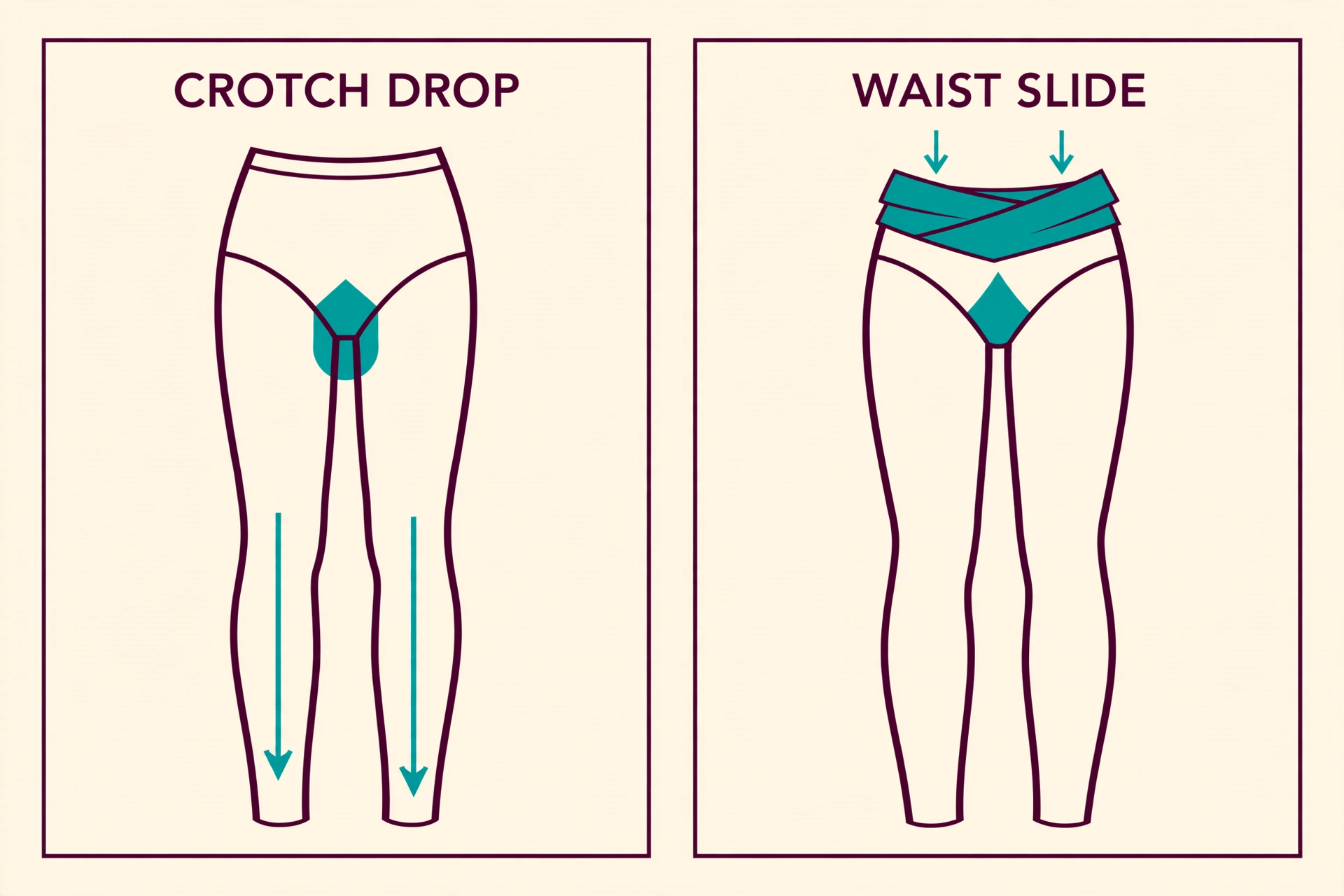
Branch 1 — The crotch drops while you’re standing
The gusset slides down and you’re hiking the pair up by the legs or waistband through the day.
- Most likely candidate: a length/fit mismatch. Here is the honest evidence position. Hosiery sizing grids are built around height and weight, not leg length — on every women’s fashion grid checked for this article (Wolford, Hanes, Falke, Snag, Capezio), there is no leg-length or inseam column at all; the same shopper lands in a different labeled size at almost every brand. So a size can fit your height and weight on paper while its legs were designed shorter than yours. One hosiery maker’s own sizing guidance (Conte, written for girls’ tights — adult application is an inference, and we flag it as one) states the mechanism plainly: when tights are too short for the wearer, the waistband sits lower than it should and the tights slip down all day, with downward pull through the legs. Wolford’s own troubleshooting similarly treats rolling down first as a size-selection problem.
- What this branch can NOT tell you: behavior alone can’t separate length from a waistband that’s failing and dragging the crotch down with it.
- The test: after a correct re-don, try the next size up — or a tall/long-line version of the same style — keeping waist and hip fit acceptable. If the gusset now seats at the crotch and survives a stand → walk → sit → stand sequence, length mismatch is supported for that pair. If nothing changes, length is not your variable; go to Branch 2.
Branch 2 — The waist slides, but the crotch stays reasonably seated
The top of the tights migrates down or the band folds at the waist, while the legs and gusset stay where they belong.
- Most likely candidate: the waistband itself — how it’s built, its condition, or its size. Tights waistbands are made several documented ways — a knitted-in welt band, a sewn-on elastic band or tape, a turned/double welt, adjustable waistbands, and shaped control-top panels (hosiery patents; Wolford and Falke construction documentation). These constructions are legitimately different things you can compare. What no credible source supports is a performance ranking between them — in particular, “a wider band stays up better” is marketing, not a documented rule, and this guide will not repeat it as advice.
- What this branch can NOT tell you: which band variable it is. This is the least directly-sourced branch of the four, so treat it as reasoning with a test attached — not a verdict.
- The test: compare against a newer, comparable pair (same style and size if you have one). If the newer pair’s band anchors and the older one slides, band condition moves up the list (see Branch 4). If a new pair slides the same way, the pattern’s band or its size in that style is the mismatch for you — compare a different construction or adjacent size next, one variable at a time.
Branch 3 — It mainly happens when you sit or move
Standing still, the pair is fine. Then you sit at a desk, bend, climb stairs — and the migration starts.
- How to read this: movement is an amplifier, not a diagnosis. Peer-reviewed anthropometry finds the waist and hip measure larger seated than standing (Bragança et al., 2016, reporting Choi & Ashdown’s posture measurements), and garment-slippage research on trousers shows posture change and movement work garments downward — worst with loose or low fits (Journal of the Japan Research Association for Textile End-Uses). Those are body-and-garment findings from adjacent evidence, transferred to tights as inference — but they explain the pattern: sitting changes your dimensions at exactly the places the tights are anchored, so a marginal fit that passes standing gets exposed seated.
- What this branch can NOT tell you: which variable is marginal. Size, length, band, and tired elastic can all present as “fine until I sit.”
- The test: wear the same pair through stand → walk → sit → stand and note where it ends up; repeat with a different outer layer (outer clothing drag can contribute). Then run whichever of Branch 1, 2, or 4 the end-state resembles. Movement onset is a trigger to observe — never the answer.
Branch 4 — It started after the pair had been worn a while
The pair behaved when new. Weeks or months later, it won’t stay up.
- Most likely candidate: wear state. The textile evidence here is qualitative but consistent: peer-reviewed work on polyamide/elastane knits — the same fabric family as hosiery — finds repeated stretching progressively reduces elastic recovery and builds in unrecovered deformation (Penava et al., Materials, 2022), and laundering studies find washing can reduce recovery and increase permanent stretch-out, with the biggest changes tending to occur early and effects that depend heavily on the fabric (Senthilkumar & Anbumani, JTATM, 2012). One honest caution runs the other way: research on washed medical compression stockings has also found shrinkage that tightens them (Polymers, 2021) — so “older means looser” is not a law, and this article gives no wash-count, month, or percentage threshold for “worn out,” because no honest one exists.
- What this branch can NOT tell you: timing alone doesn’t prove degradation — only comparison does.
- The test: the qualitative comparison against a fresher pair of the same style and size. Stretch both waistbands side by side and let go: if the older band stays visibly more stretched-out and pulls back more slowly or weakly, that points toward lost recovery in that pair. If both behave the same, condition probably isn’t your variable — return to Branches 1 and 2. This is a comparison, not a measurement; it cannot tell you how much life a pair has left.
Why the size grid itself is part of the problem
Understanding your grid explains why “just size up” is unreliable advice here:
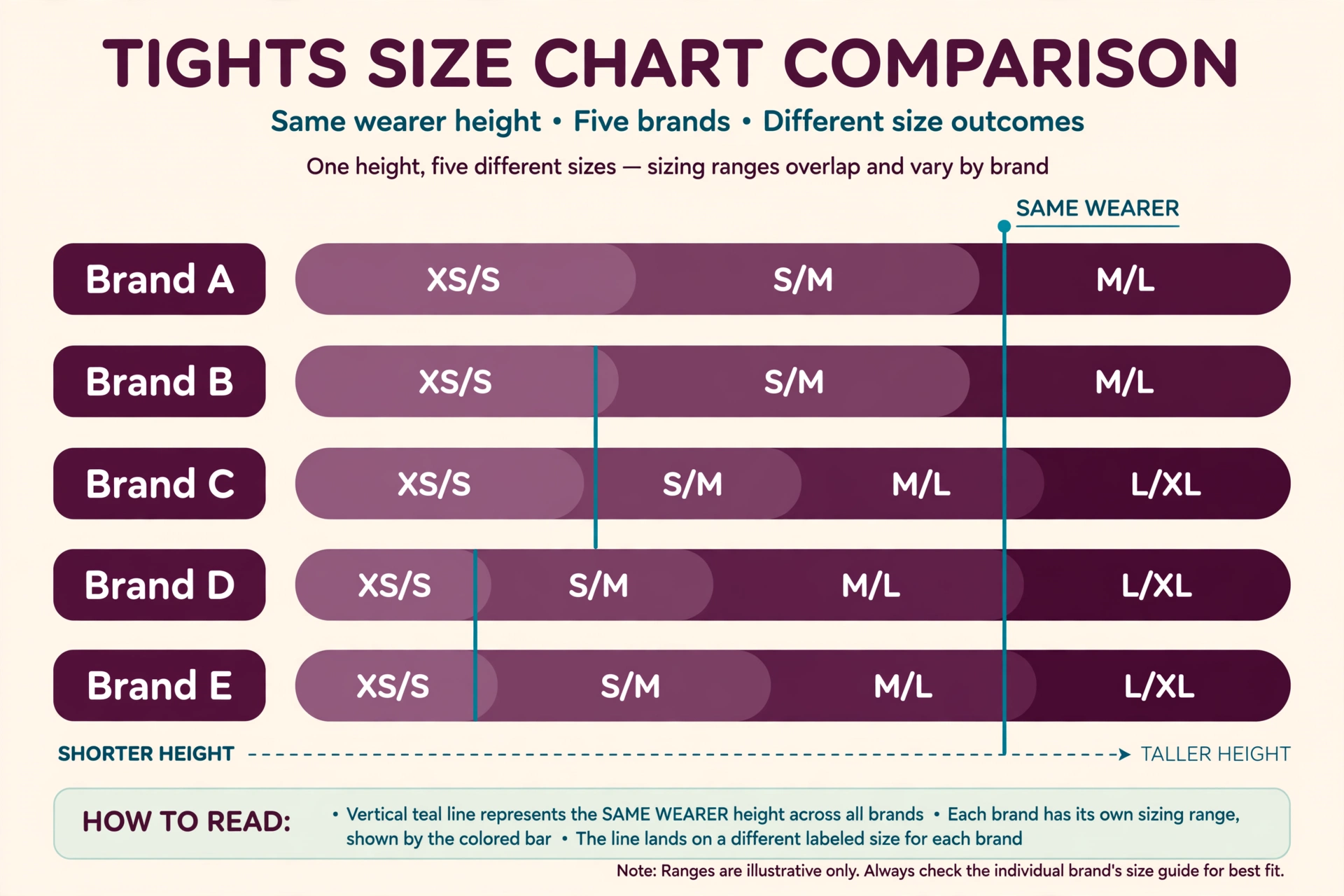
- The axes are height and weight. One maker’s grid spans enormous territory per size — Wolford’s size M alone covers heights from 59–75 inches and weights from 99–187 lb, overlapping its neighbors on both sides. Hanes says the quiet part out loud: the height ranges overlap because nylon/spandex hosiery is designed to stretch both vertically (for height) and horizontally (for width). A grid is a stretch budget, not a fit guarantee.
- Brands disagree about you. At 5’6″ and 150 lb, the grids checked here put the same wearer in Wolford S, Hanes C/D, Falke L, Snag D, and Capezio L/XL. There is no universal size to “get right” once — only this brand’s grid to read. (Our guide to how to read a lingerie size chart covers chart-reading generally; tights add the leg-length twist below.)
- Length is mostly not on the chart. Dance hosiery for men sizes by explicit inseam bands — proof the industry can publish leg length — but women’s fashion grids omit it, leaving length handled only through product variants (Snag sells a “Short F”; some Falke lines come in short-to-long leg lengths). If Branch 1’s test points to length, those tall/long variants — or the next size up — are the comparisons that exist, because the grid won’t answer the question directly.
The waistband, honestly: compare constructions, don’t chase slogans
Because the waistband anchors the whole system, it’s worth knowing what you’re looking at when you shop:
- Knitted-in welt band — the band is knitted into the garment itself, usually with elastic yarn (documented in Wolford product documentation).
- Sewn-on elastic band or tape — a separate elastic attached to the top.
- Turned/double welt — the top folds over and is secured.
- Adjustable waistbands — threaded elastic or adjustable-rise designs exist in some lines.
- Control/shaping top panels — a shaped, firmer body section knitted into the tights (a different hold system from the band alone).
These are construction facts. Fiber makers publish genuinely interesting waistband research — one fiber manufacturer’s 2024 consumer survey found waistband complaints (digging, slipping, rolling) among hosiery wearers’ top pain points — but manufacturer performance promises for a given band are marketing, and width alone has no documented staying-up rule. Compare constructions the way you compare sizes: same wearer, one variable changed, sit-test the result.
Care notes the evidence actually supports
- Follow the maker’s care limits. Hunkemöller’s tights guide, for example, specifies washing at 30° with no tumble drying, ironing, or bleach. Follow the care label your pair came with — care preserves elastic; it cannot restore recovery that is already lost (see the last note in this section).
- Judge a pair’s fit early. Since the largest recovery changes in textile studies tend to occur in the first washes, a pair that falls from day one is telling you a fit/length/band story (Branches 1–2), not a wear story. Save the wear diagnosis for pairs that changed.
- There is no restoring dead elastic. Once recovery is lost, no wash brings it back; the fresher-pair comparison in Branch 4 is how you make the replace decision without invented thresholds.
Two boundaries, stated plainly
This is not the stay-up problem. Thigh highs and stockings stay up by silicone grip on the leg or by a garter belt — a different anchoring system with its own failure modes, covered in our garter belt guide. Nothing there transfers here, and nothing here diagnoses a slipping stay-up.
This is not the panty-waistband problem. Panties fail at a free waistband; tights are hung from the waist and tensioned along the whole leg, which is why they get their own router (theirs is in our guide to why panties keep rolling down). Similar-looking waist slide, different tension system, different tests.
And three exclusions for the record: this guide doesn’t cover leggings (an athletic garment with different construction), shapewear (built to compress, assessed differently), or medical/compression hosiery as treatment — compression donning guides are cited above only for the documented mechanics of putting hosiery on, never for therapy guidance.
FAQs
Is it me, or are my tights just the wrong size?
Usually neither slogan fits. Tights grids stretch across wide, overlapping ranges and disagree between brands, so “wrong size” is one candidate among four — and the only way to know is the branch test that matches your pattern: re-don first, then size/length, band, or fresher-pair comparison.
Should I just buy the next size up?
Only as a test, and only in the branch where it means something: Branch 1, where a size up (or a tall/long version) tests the length hypothesis. If the gusset seats and stays through sitting, you learned something. Sizing up blindly can trade a crotch problem for a waistband problem.
Why do my tights fall down only when I sit down?
Sitting measurably changes waist and hip dimensions (posture research), which may expose a fit that was already marginal — without telling you which variable is responsible. It’s the most common pattern in this guide and the least diagnostic — it tells you to run the tests, not which one will pass.
Do tall or long-leg tights actually exist?
Yes, but as product variants rather than grid columns: some brands sell short and long leg lengths of the same style, and dance hosiery publishes explicit leg measurements. If Branch 1’s test supports a length mismatch, a long-line variant of your style is the cleanest comparison available.
Can I fix tights whose elastic has given out?
No — lost recovery is permanent. The fresher-pair comparison (stretch both bands, watch the pull-back) is the honest test; a band that stays stretched and returns weakly is a replace decision, not an adjustment.
Bottom line
Tights fall down for separable reasons, and the observations separate them only when each one is paired with its test: re-don correctly before blaming the garment; test length with a size up or long line; test the band against a fresher pair; treat sitting as the spotlight, not the culprit; and judge wear by comparison, never by a number. Do that, and “my tights keep falling down” turns into one specific, fixable mismatch — a different one, possibly, at every brand.
Sources
- Wolford, hosiery size chart & Neon 40 documentation (height × weight grid; rolling-down troubleshooting).
- Hanes, tights size chart and manufacturer sizing statement (grid overlap rationale).
- Falke, ladies’ hosiery size guide (height × weight × hips).
- Snag, tights size guide (clothes-size × height bands; “Short F” length variant) and Snag/Next hosiery fit guidance (gusset criterion).
- Capezio, dance hosiery charts (height × weight; explicit inseam in men’s lines).
- Conte, tights sizing guidance (too-short tights: low waistband, slipping, gusset position).
- Brownfields, Proper Application of Compression Garments (donning sequence; never pull the upper edge).
- L&R (Activa/ActiLymph), compression hosiery application guide (gather-and-ease donning).
- Hunkemöller, tights care and wear instructions (donning sequence; 30° wash care limits).
- Penava, Vrljičak & Jankoska, Materials (2022) — elastic recovery of polyamide/elastane knits under cyclic loading.
- Senthilkumar & Anbumani, JTATM (NC State, 2012) — laundering effects on elastic recovery and permanent set.
- Polymers (2021), care-labelling study of cotton compression stockings — washing changed dimensions and performance (tightening direction; compression context).
- Bragança, Arezes, Carvalho & Ashdown (2016), reporting Choi & Ashdown — standing vs sitting body-dimension changes.
- Journal of the Japan Research Association for Textile End-Uses — garment slippage under posture change and movement.
- Hosiery waistband construction: US/WO hosiery patents; Wolford and Falke product documentation; The LYCRA Company waistband consumer research (2024).