The Quick Answer (30 Seconds)
A corset and a bustier look similar — structured, boned, often lacy — but they are built to do different jobs.
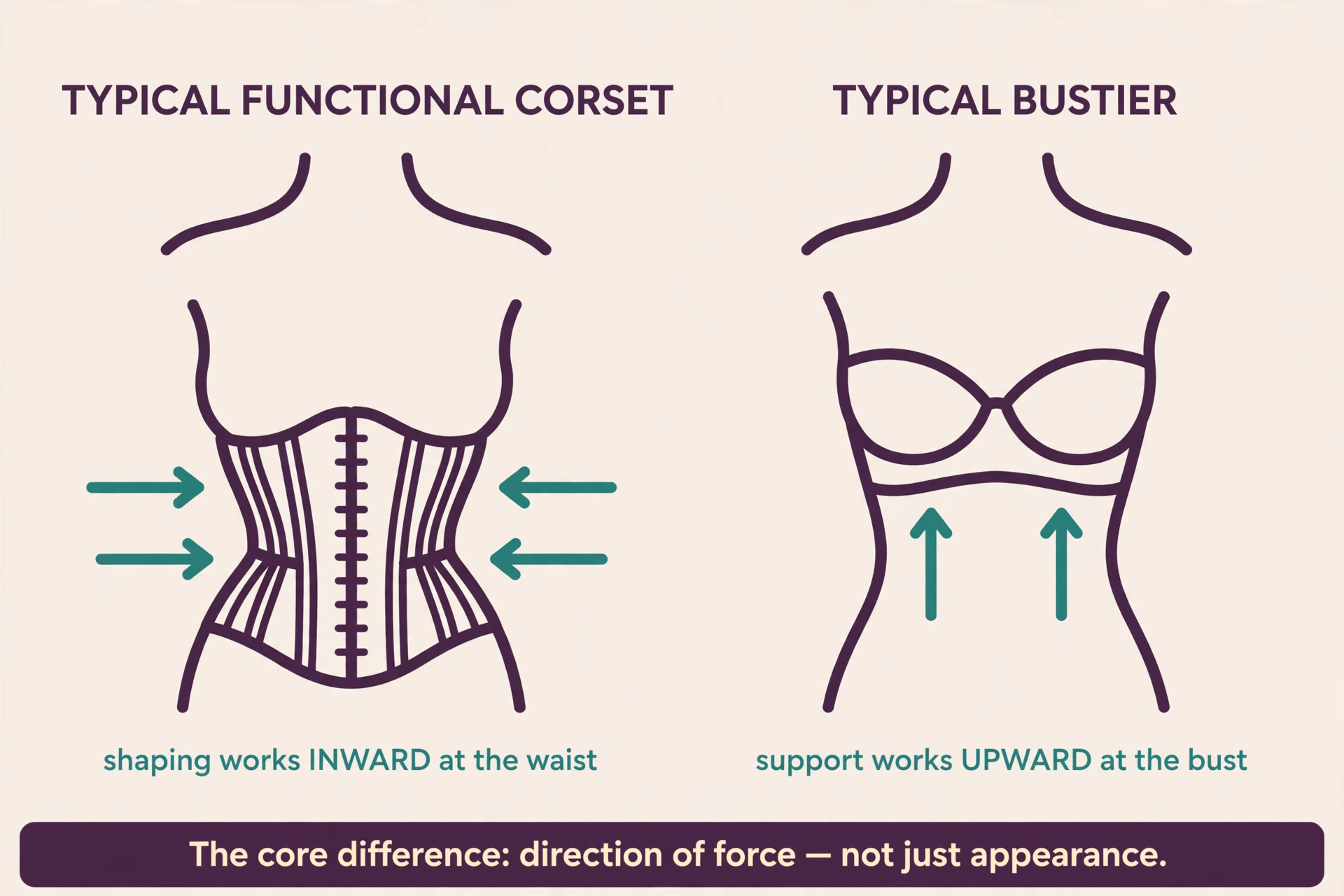
- A corset is a torso-shaping garment. Its structure works inward at the waist: rigid boning, an internal waist tape, and a lacing system that compresses and shapes the midsection. A true corset is sized by closed-waist inches, not by dress size.
- A bustier is a bra-derived garment. Its structure works upward at the bust: supportive cups (usually underwired), a longline band extending down the torso, and lighter flexible boning that keeps the band smooth. It is sized more like a bra or like clothing.
The confusion is understandable, because the product title alone won’t tell you which one you’re looking at. Fashion retailers sell “corsets” that are really shaped tops with plastic boning and a zipper, and some “bustiers” are built closer to soft shapewear than to any corsetry. Read the garment, not the label. This guide teaches you how.
What a Corset Is
A functional corset is a structured garment whose intended purpose is shaping and supporting the torso — most centrally, the waist. Its construction is what makes it a corset, not its appearance:
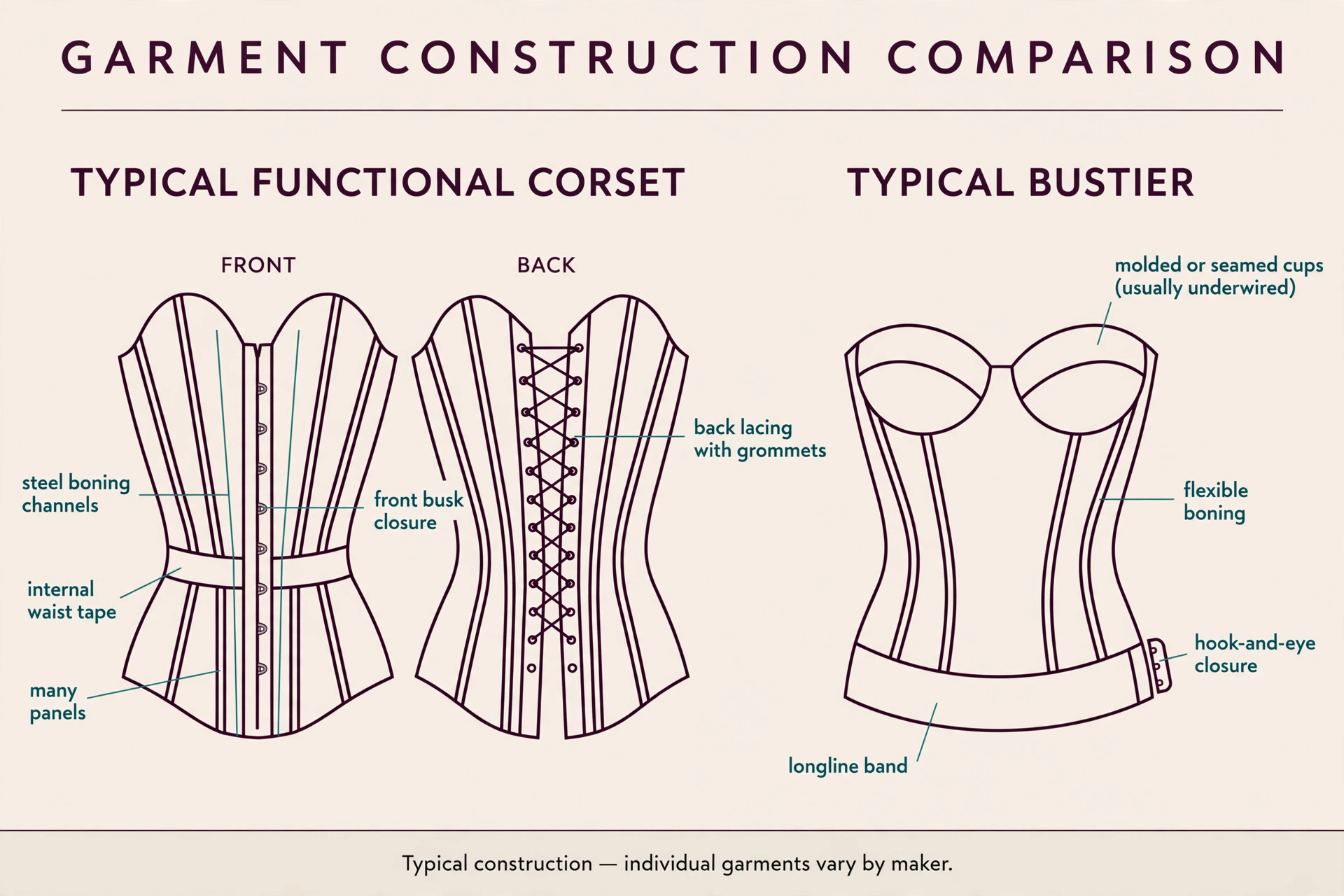
- Rigid boning, typically steel in authentic corsetry. Flat steel boning sits near the back lacing and front closure for stiffness; spiral steel follows the body’s curves along the sides (WAWAK).
- An internal waist tape — a strong ribbon sewn inside the garment at the waistline that anchors the shaping and takes the strain off the fabric.
- A lacing system at the back paired with a front busk closure (a rigid two-part metal closure that also serves as the front opening).
- Multiple panels (often 10–20+) cut to create the garment’s specific silhouette.
- Sizing by closed-waist measurement in inches — a corset’s size is the measurement of the closed corset at the waist tape, not your body size.
Two functional variants exist:
- Underbust corset: begins beneath the breasts and ends around the hips. It provides no bust support — you wear a bra with it. This is the most common modern functional corset.
- Overbust corset: extends from under the arms to the hips, with shaped cups that also lift and support the bust while shaping the waist.
Important: not everything sold under the name “corset” is built this way. Fashion “corsets” and corset tops may use plastic or Rigilene boning, zipper or hook closures, no waist tape, and standard S/M/L sizing. They are shaped tops, not shaping garments — a distinction the label-decoder section below teaches you to spot.
What a Bustier Is
A bustier starts from the opposite end: it is bra-derived. HerRoom’s lingerie glossary defines it as “a corset-style garment that combines a bra and a waist-cincher, designed with a longline band that extends down the torso and supportive cups that ‘boost’ the breasts,” noting its “flexible boning” and “hook-and-eye closure,” and that, compared with corsets, “they lift the bust instead of flattening it.”
Typical bustier construction:
- Supportive cups — molded or seamed, usually underwired, like a bra’s cups.
- A longline band extending from the ribs down toward the waist or upper hip, distributing the bust’s weight over more torso than a standard bra band.
- Flexible boning — plastic, Rigilene, or light steel — that keeps the extended band from rolling or folding, not boning meant to cinch the waist.
- Hook-and-eye or zipper closures, like a bra’s (some bustiers have a lace-up back, which is why construction — not the closure alone — is the test).
Historically, the bustier was literally called the “long line brassiere.” Its primary job is bust lift and support; any waist effect is smoothing, not reduction. That is the opposite direction of force from a corset: up at the bust, not inward at the waist.
Like corsets, bustiers vary by maker: some have no boning at all (modern mesh-panel designs), some are cup-sized like bras, others are S/M/L. The chart — not the label — decides.
The Construction Map
Side by side, the differences are mechanical, not cosmetic. The table below describes the typical functional version of each; variation exists and is flagged throughout.
| Dimension | Functional corset | Typical bustier |
|---|---|---|
| Primary job | Waist/torso shaping and support | Bust lift and support |
| Direction of shaping | Inward at the waist | Upward at the bust |
| Boning | Steel (flat near closure/lacing, spiral along curves) | Flexible plastic/Rigilene or light steel; some have none |
| Waist reinforcement | Internal waist tape | None |
| Closure | Front busk + back lacing | Hook-and-eye or zipper; rarely laced |
| Cups | Overbust: shaped cups; underbust: none (wear a bra) | Molded or seamed cups, usually underwired |
| Panels | Many (often 10–20+), cut for a specific silhouette | Fewer; bra-like construction extended downward |
| Length | Longer: waist to hips | Shorter: ribs to waist or upper hip |
| Sizing | Closed-waist inches | Bra/cup-based or apparel S/M/L |
| Adjustability | High (lacing tightens/loosens continuously) | Low (fixed hooks; what you buy is what you get) |
| Expected fit behavior | Shapes the waist when laced; cinching is the point | Lifts the bust; waist effect is smoothing at most |
Read it as a tendency, not a law. A compression-fabric bustier can smooth the upper tummy noticeably; a fashion “corset” may do neither job. The construction you can verify beats the label you can read.
The Sizing Chaos: Three Systems, One Label
This is where most disappointment is born. Three different sizing logics are sold under the same family of product names:
1. Corsets sold by waist measurement. A true corset’s size is the closed-waist measurement in inches. As a working corsetiere explains, “a corset’s size is based on the measurement of a closed corset at the waist tape” — so you buy a size smaller than your natural waist. How much smaller varies by maker and purpose: roughly 6 inches below the natural waist for classic styles (about 4 inches for smaller waists), while other makers’ ranges run 4–7 inches. Some makers even use letter sizing or stretch fabrics with their own rules. The maker’s chart — not a universal number — is the authority.
2. Bustiers using bra or cup sizing. Many bustiers are sold in bra-style sizes (e.g., 34C, 36D) or in letter sizes tied to cup ranges on the chart. Because the garment is bra-derived, the bust measurement drives the size, just as with a bra.
3. Bustiers — and fashion “corset tops” — using apparel sizing. Plenty of bustiers and nearly all fashion corset tops use standard S/M/L sizing, sometimes with bust-and-waist ranges on the chart. A fashion “corset” in size M has no waist-reduction expectation at all; the letter tells you almost nothing about shaping.
The takeaway: the product’s own sizing chart matters more than any assumption based on the label. A “corset” sized S/M/L is not sized like a corset. A “bustier” sold in cup sizes wants your bra size, not your dress size. Our guide to reading lingerie size charts covers how to use any brand’s chart as the decision tool — the principle applies doubly here, where the labels are the least trustworthy.
Real Corset vs Fashion “Corset Top”: The Label Decoder
If the listing calls it a corset, run this inspection before buying. Each answer moves you toward “functional corset” or “fashion top”:
1. The back. Real lacing — crisscrossed laces through grommets, ideally with a modesty panel behind — is the signature of functional corsetry. A zipper, a row of hooks, or a plain elastic back means fashion top, whatever the title says.
2. The front closure. A busk (rigid two-part metal closure) signals corsetry. Simple hooks or a zipper signal fashion.
3. The boning description. “Steel boned” (flat or spiral steel) signals function; “plastic boning,” “Rigilene,” “flexible boning,” or no mention at all signals fashion. Be skeptical of listings that say “steel boned” with no further detail — some abuse the phrase.
4. Waist reinforcement. A mention of waist tape (or “waist ribbon”) is a strong functional signal. Fashion tops never mention it, because they don’t have it.
5. The sizing chart. Inches-at-the-waist = corsetry. S/M/L with no waist measurements = fashion. This is the single fastest test.
6. Cup construction (for overbust styles). Structured, shaped cups suggest function; unshaped cups or none suggest fashion.
7. Garment measurements. Functional corsets publish waist, underbust, hip, and sometimes torso-length measurements. Fashion tops publish bust/waist/hip like any shirt — or nothing at all.
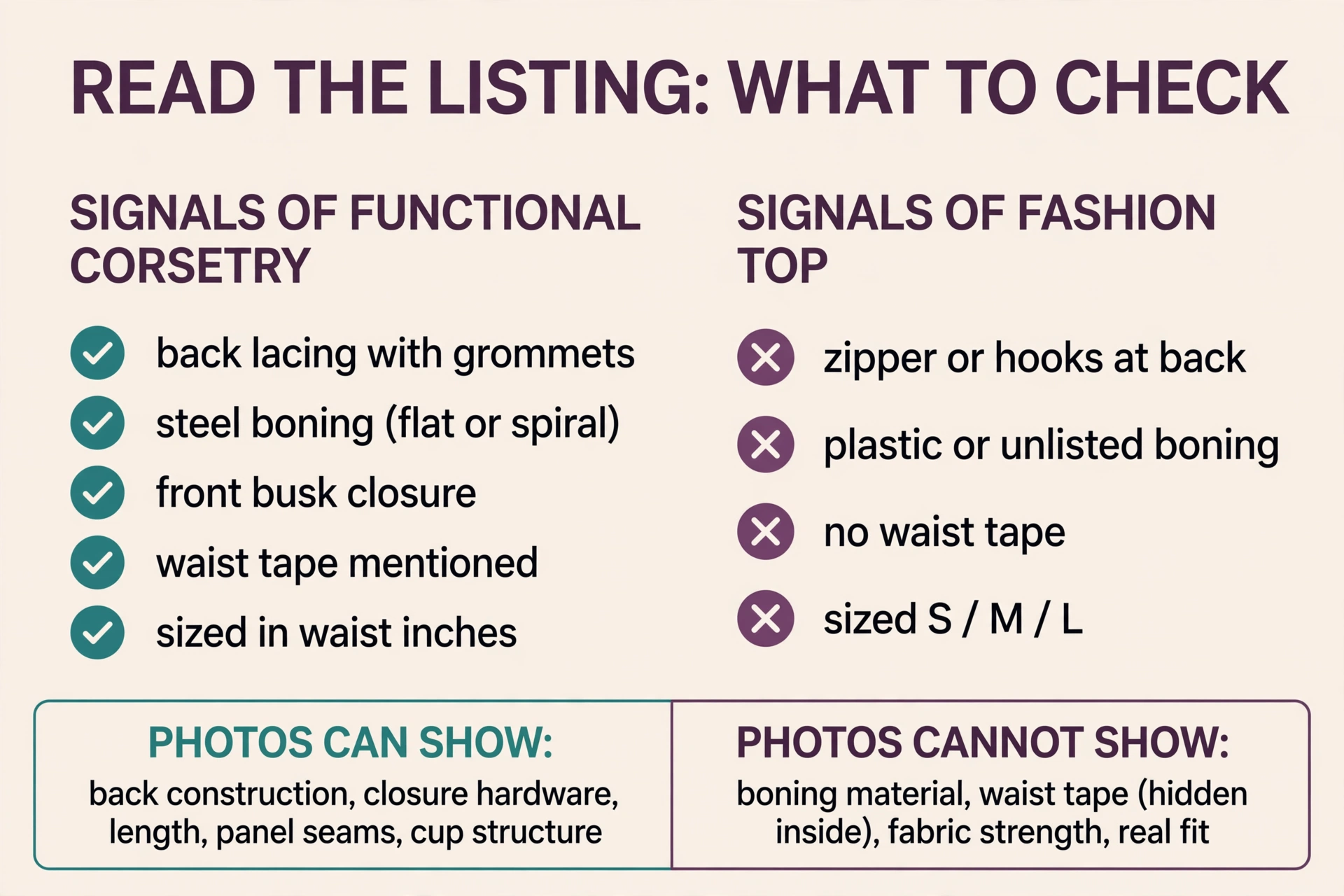
What product photos can tell you: the back construction (lacing vs zipper), the front closure hardware, the garment’s length and silhouette, panel seams, and whether cups are structured. What photos cannot tell you: the boning material (steel and plastic look identical in a photo), whether a waist tape exists (it’s inside the garment), the fabric’s strength, or how the garment actually fits a body. A photo alone is never proof of hidden construction — verify against the listing’s construction description and sizing chart.
Bustier vs Longline Bra vs Basque: Boundary Notes
These neighbors cause their own confusion; a short map keeps the comparison clean:
- Bustier vs longline bra: historically the same idea — the bustier was called the “long line brassiere.” Today, “longline bra” usually means a bra with an extended band (a few inches), while “bustier” usually means a longer, more structured garment with cups, boning, and often strapless wear. The boundary is soft and brand-dependent.
- Bustier vs basque: a basque is the longer cousin — similar construction, but extending further down over the hips. If it covers the hip, suspect basque; if it stops at the waist, suspect bustier — but brands mix the terms.
- What stays separate: a full longline-bra comparison is a future article, not this one. This section exists only so the reader doesn’t confuse the neighbors with the main event.
Which Should You Choose? A Decision Path
Neither category is universally better. Match the garment to the job:
- You mainly want waist/torso shaping → a functional corset (underbust if you’ll wear your own bra; overbust if you want bust support built in).
- You mainly want bust lift and support, especially strapless → a bustier.
- You want a lingerie foundation under fitted clothing → either works; a bustier is the simpler choice, a corset the more shaping one.
- You want a structured top to wear visibly → a fashion “corset top” is honest for this job; don’t pay corsetry prices for fashion construction.
- You want adjustability through the day → lacing (functional corset) is continuously adjustable; a bustier’s hooks are fixed.
- You have specific fit requirements (long torso, full bust, sensitive ribs) → check the maker’s measurements against your body, not the label; underbust corsets and cup-sized bustiers are the most accommodating formats.
The expensive mistake is buying a fashion corset top and expecting corsetry — or buying a true corset and expecting bra-like convenience. Name the job first; the construction follows.
Fit Checks: Bustier
Because a bustier is bra-derived, its failures look like bra failures on a longer band:
- Cups gaping at the top — the same geometry problem as in any bra. Our guide to why bra cups gape at the top covers the causes; the fix here is usually a different cup size or a different bustier cut, not tighter hooks.
- The band riding up at the back — the longline band needs to anchor like any band. If it climbs, the size or the band’s grip is wrong; the mechanics are the same ones in our guide to why bra bands ride up.
- Bust spilling from the cups — the cups are too small; go up in the cup (or check the chart’s cup logic) rather than squeezing into the band.
- The garment folding or collapsing at the waist — usually too little boning for the torso length, or a size too large to hold tension. More structure (or a shorter garment) is the fix, not more tightness.
Fit Checks: Corset
Functional corsets have their own diagnostic language, centered on the lacing:
- The lacing gap is your fit readout. A roughly parallel gap of a couple of inches at the back is normal and correct — the gap is part of the design, not a flaw. Edges that converge or diverge sharply (wide at top, narrow at waist, wide at hip) signal the wrong shape for your proportions, and the garment will pinch.
- The busk strains or gaps at the front — the corset is too small; a busk under constant strain will eventually fail.
- No waist reduction despite full lacing — you likely ordered at your natural waist size (in which case the corset can’t cinch and will sit loose), or you bought a fashion corset with no waist tape. This is a wrong-garment-category problem, not a tightness problem.
- Digging at ribs or hips when sitting — often a torso-length mismatch: the garment is too long for your torso. A shorter style or a different cut is the fix.
- Folding or wrinkling along the panels — too large, or too little boning; the fabric has nothing to hold it smooth.
Separate the four causes every time: wrong size (busk strain, no cinch), wrong proportions (uneven lacing gap, rib/hip digging), wrong garment category (fashion top bought for shaping), normal design behavior (a parallel lacing gap is supposed to be there).
Buying Checklist: Read the Garment, Not the Label
- Name the job first — waist shaping, bust support, visible top, or foundation.
- Inspect the back — lacing with grommets (functional) vs zipper/hooks (fashion).
- Inspect the front closure — busk (functional) vs hooks/zipper (bra-like or fashion).
- Read the boning description — steel (functional) vs plastic/Rigilene/flexible (fashion or bustier); no mention means assume fashion.
- Check for waist tape — mentioned means functional corsetry; never mentioned in fashion.
- Read the sizing chart, not the title — waist inches (corset), cup/bra sizes (bra-like bustier), S/M/L (fashion). Buy to the chart’s logic.
- Check garment measurements — waist, underbust, hip, and torso length if published; compare to your body.
- Judge photos for what they show — construction you can see; never assume what you can’t (boning material, waist tape).
- For bustiers, check the cups like a bra — underwired? molded or seamed? cup-sized or S/M/L?
- Confirm the return policy — structured garments are the hardest lingerie to fit from a screen; you need a real try-on.
A Short Note on Safety
Structured garments compress the torso, so fit discipline matters more here than with ordinary lingerie:
- Pain, numbness, or difficulty breathing are fit failures, not signs the garment is “working.” A properly fitted corset should never cause pain, numbness, or shortness of breath — if it does, it is laced too tightly or is the wrong shape, and the answer is to loosen or remove it, not to endure it.
- Breathing: tight lacing can make it harder to take a full breath. A small 2018 study found reduced maximum voluntary ventilation while wearing a waist trainer (Healthline). This is about tight compression garments generally, not an argument about any specific corset.
- Numbness and tingling (particularly in the outer thigh or torso) can signal nerve compression from tight garments; persistent symptoms deserve medical attention, not tighter lacing.
- Waist training and tightlacing are separate, serious practices with their own health considerations — this guide compares garments; it does not teach waist reduction methods, and no safe compression amounts, reduction targets, or wear-time limits are given here because none can be stated universally.
- As with any garment: sudden pain, skin breakdown, or persistent numbness means stop and seek advice, not a better size.
FAQ
Is a bustier just a short corset?
No — that is the most common misconception. A bustier is bra-derived: its structure exists to lift and support the bust, with cups and a longline band. A corset’s structure exists to shape the waist, with steel boning, a waist tape, and lacing. Similar appearance, opposite primary jobs.
Can a bustier shape my waist like a corset?
Not meaningfully. A bustier can smooth the upper torso, but it has no waist tape, no lacing system, and no rigid boning — the three things that let a corset reshape the waist. If waist reduction is the goal, a fashion “corset” won’t do it either; only functional corsetry does.
What’s the difference between a corset top and a real corset?
Construction. A real (functional) corset has steel boning, a waist tape, a busk front, back lacing, and waist-inch sizing. A corset top looks similar but typically uses plastic boning, a zipper or hooks, no waist tape, and S/M/L sizing. Check the back, the boning description, and the sizing chart — the product title won’t tell you.
Should I buy a corset in my normal clothing size?
No. Functional corsets are sized by closed-waist inches — you buy several inches below your natural waist, per the maker’s chart (makers’ recommendations vary, commonly in the 4–7 inch range). A corset sold in S/M/L is a fashion garment, not sized like corsetry.
Do I need a bra with an underbust corset?
Yes. An underbust corset provides no bust support — it starts beneath the breasts. Wear your own bra with it. An overbust corset includes shaped cups and can replace the bra.
Why is there a gap in the lacing at the back of my corset?
A roughly parallel gap of a couple of inches is normal — it is part of the design and gives you adjustment room. A gap that is much wider at the top or bottom than at the waist signals the wrong shape for your proportions.
The bottom line
“Corset” and “bustier” are labels; construction is the truth. A functional corset shapes the waist with steel, a waist tape, and lacing, and is sized in waist inches. A bustier lifts the bust with cups, a longline band, and flexible boning, and is sized like a bra or like clothing. Fashion “corset tops” borrow the look with neither job’s construction. Inspect the back, the boning, the closure, and the sizing chart — read the garment, not the label — and match the construction to the job you actually want done.